Egypt’s Western Desert is enormous enough to make a normal road trip feel insignificant.
Beyond the Nile Valley, paved roads eventually give way to oasis settlements, chalk formations, black-topped hills, immense dune systems, empty plateaus, hot springs, and stretches of desert where another vehicle may not appear for hours.
That scale is exactly what makes the region exciting – and why proper planning matters. Learning how to plan a multi-day expedition across the Western Desert involves much more than booking a 4×4 and packing a tent.
You need a realistic route, an experienced guide, permits, backup transportation, enough water and fuel, suitable camping equipment, and contingency plans if weather or access conditions change.
For most travellers, the practical introduction is the oasis corridor connecting Bahariya, Farafra, Dakhla, and Kharga. Egypt’s official tourism portal recommends this “Desert Circuit” for visitors with roughly a week or more available.
Done properly, the journey becomes less about covering distance and more about experiencing how dramatically the Sahara changes from one landscape to the next.
Choose a Route That Matches Your Available Time
The biggest planning mistake is trying to cross too much desert in too few days.
If you have only two or three nights, concentrate on Bahariya, the Black Desert, and the White Desert. Bahariya sits roughly 370 kilometres southwest of Cairo and is the closest major Western Desert oasis to the capital, making it a practical gateway for shorter expeditions.
With five to seven days, consider continuing through Farafra toward Dakhla. Farafra gives access to the White Desert, Crystal Mountain, Agabat Valley, and sections of the Great Sand Sea, while Dakhla introduces greener agricultural landscapes and historic oasis settlements.
A week or more makes the classic Bahariya–Farafra–Dakhla–Kharga circuit more realistic. Kharga can then connect you toward the Nile Valley and Luxor, creating a logical one-way expedition rather than forcing you to return to Cairo.
Leave some unscheduled time. Desert travel frequently takes longer than distances on a map suggest.
Build the Expedition Around Licensed Local Expertise
A desert-capable vehicle does not make someone a desert guide.
Egypt’s official tourism guidance specifically recommends using specialized or licensed operators for excursions around Farafra and checking permits and regulations before departure.
Ask potential operators how long they have worked in the Western Desert, which routes they regularly drive, how they handle mechanical problems, and whether they arrange permits themselves.
Also ask who will actually accompany you. The person answering emails in Cairo may not be the person navigating dunes several days later.
A strong guide does more than drive. They know where legal camping areas are, how desert tracks change, where water and fuel can be replenished, how to communicate with checkpoints, and when an apparently straightforward route should be avoided.
Current access conditions matter too. Some desert corridors can be restricted or closed with relatively little relevance to older guidebooks.
Treat Permits as Part of the Itinerary
Do not assume that remote desert areas are freely accessible simply because they appear on travel maps.
Current UK government travel advice states that visitors entering Bahariya Oasis, Farafra, the White Desert, and Black Desert must arrange permits in advance and use an official guide.
It also warns of limited mobile reception and poor medical facilities in remote Western Desert areas.
Some historic routes may have additional restrictions.
For example, current UK advice warns against all but essential travel along the Bahariya–Siwa road and notes road closures and military checkpoints. Conditions can change, which is exactly why a desert itinerary downloaded months earlier should never be treated as final.
Ask your operator to confirm permits shortly before departure.
If a route becomes unavailable, have an alternative rather than pressuring a driver to improvise around official restrictions.
Use More Than One Vehicle for Longer Remote Sections
Vehicle redundancy becomes increasingly important as you move farther from paved roads.
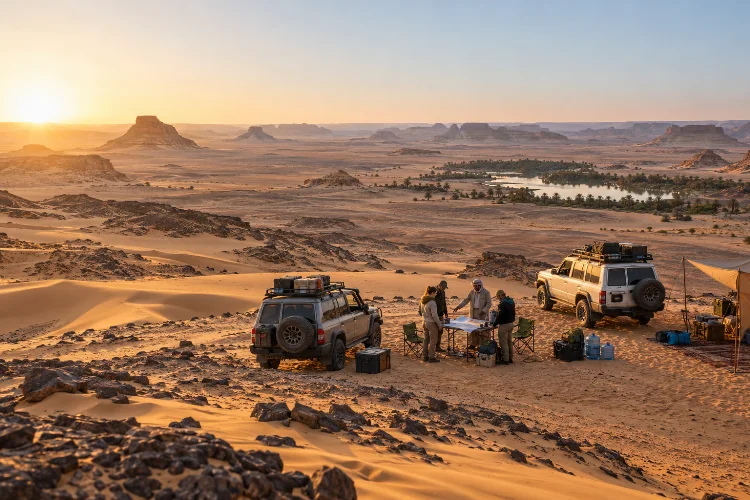
Experience Egypt recommends an additional support vehicle for overnight camping trips lasting more than two or three days. Its wider desert guidance also advises travelling with two or more vehicles on long journeys far from a road.
The reason is simple.
A puncture can be repaired. A major suspension failure, damaged fuel system, or vehicle stuck far from help is a different situation entirely.
Before departure, check that vehicles carry suitable spare tyres, recovery equipment, basic tools, extra fuel where necessary, and communications equipment appropriate to the route.
Pay attention to vehicle condition as well. Worn tyres, poorly secured loads, or improvised fuel storage are warning signs.
Good desert logistics should feel slightly overprepared. That is preferable to discovering halfway through an empty plateau that something important was forgotten.
Plan Water, Food, and Fuel Conservatively
Water is the most important supply calculation of the entire trip.
Never base quantities only on what you expect to drink. Water may also be needed for cooking, emergencies, basic washing, or delays that extend the trip.
Your operator should carry reserves beyond the planned consumption of the group.
Food is easier but still deserves thought. Multi-day camps generally work best with simple ingredients that tolerate heat and transport well. Meals can be surprisingly good—fresh bread, vegetables, rice, grilled food, fruit, tea—but complicated refrigeration adds unnecessary risk.
Fuel planning should be handled by the guide and drivers, especially when an itinerary includes significant off-road travel.
Oasis settlements provide opportunities to resupply, which is another reason routes linking Bahariya, Farafra, Dakhla, and Kharga are more practical than attempting huge uninterrupted desert crossings.
Do not pack the vehicle to its absolute capacity. Equipment needs to remain secure when driving over rough or steep terrain.
Mix Desert Camping With Oasis Stops
Sleeping outside is one of the highlights of a Western Desert journey, but camping every night is not automatically the best itinerary.
Alternate remote camps with oasis accommodation when possible.
After two nights of sand, wind, and minimal facilities, a simple eco-lodge in Farafra can feel remarkably luxurious. Experience Egypt notes that Farafra has basic eco-lodge accommodation as well as hot springs and oasis gardens that provide a natural break from desert driving.
This also creates time to recharge devices, reorganize equipment, restock water, and clean dust from everything you own.
For camps, ask what the operator actually provides. “Full camping equipment” can mean anything from proper tents and mattresses to a few blankets laid on the ground.
Night temperatures can drop sharply compared with daytime conditions, so bring warm layers even when afternoons are comfortable.
A headlamp, power bank, compact personal first-aid kit, and dust-resistant bags for electronics are also worth carrying.
Make the Landscape the Itinerary
Multi-day desert travel becomes tedious if every day is described only as “drive to the next oasis.”
Build the journey around changing environments.
Near Bahariya, contrast green palm groves with the dark hills of the Black Desert. Continue toward Crystal Mountain and Agabat Valley before entering the White Desert, where wind-shaped chalk formations create one of Egypt’s most recognizable natural landscapes.
The White Desert Protected Area covers roughly 3,133.5 square kilometres and is protected for its chalk formations, fossils, karst features, wildlife, and prehistoric remains.
Farther south, Dakhla and Kharga introduce archaeological sites and long-established oasis communities. Kharga, for example, preserves the Temple of Hibis, the early Christian necropolis of al-Bagawat, and several Graeco-Roman monuments.
Keeping the itinerary varied prevents “desert fatigue.” Dunes, archaeology, villages, springs, chalk landscapes, and agricultural oases each provide a different reason to stop.
Allow Enough Time Outside the 4×4
Spending eight hours every day inside a vehicle defeats much of the purpose of a desert expedition.
Ask your guide to include proper walking stops.
An hour exploring chalk formations on foot can reveal far more than another 50 kilometres of driving. The same applies to oasis gardens, old settlements, archaeological remains, and dune landscapes.
Short hikes also give your body a break from rough tracks.
The White Desert excursions promoted by Egypt’s tourism authority can range from one to ten nights and may incorporate hiking, camping, camel travel, and 4×4 exploration. That flexibility is worth using.
Do not make the itenerary so ambitious that every sunset happens while you are still driving toward camp.
Some of the best moments happen when there is nowhere left to go: tea after sunset, a short walk beneath the stars, or an hour watching the desert change colour in complete silence.
Prepare for Limited Communication and Medical Support
Remote travel requires a different attitude toward everyday problems.
Phone reception can be limited or nonexistent, and high-quality medical care may be many hours away. That makes relatively minor issues – dehydration, stomach illness, a twisted ankle—more significant than they would be in Cairo.
Tell your operator about dietary needs or mobility limitations before departure.
Bring essential personal medication in sufficient quantities plus a small reserve. Keep medications protected from extreme heat where required.
Travel insurance should cover the specific activities included in the expedition, particularly off-road travel and remote-area evacuation where available.
Your guide should also know the emergency communication plan.
Ask the question before leaving: if someone becomes seriously ill at the most remote camp, what happens next?
A professional operator should have a clearer answer than “we’ll figure it out.”
Travel Carefully Through Protected Landscapes
The empty desert can create the illusion that nothing you do will matter.
In reality, vehicle tracks can remain visible, fragile chalk formations can break, and fossils or minerals removed as souvenirs lose much of their scientific value.
Stay on approved routes where required. Avoid driving unnecessarily through sensitive areas, remove all rubbish, and do not break pieces from geological formations.
Egypt’s environmental authority specifically protects the White Desert because of its unusual geological structures, fossils, wildlife, and archaeological evidence.
Do not climb fragile chalk sculptures simply for photographs.
A good operator should leave campsites looking almost exactly as they were found. Responsible expedition travel means enjoying remoteness without creating permanent evidence that your group was there.
A Practical Seven-Day Western Desert Structure
For a first multi-day trip, a week provides a useful balance.
You might travel from Cairo to Bahariya on the first day, explore the oasis and nearby desert, then spend the second and third days moving through the Black Desert, Crystal Mountain, Agabat Valley, and White Desert.
Continue to Farafra before moving toward Dakhla, where an overnight stay provides time for oasis landscapes and historic settlements.
From there, continue south toward Kharga for archaeological exploration before reconnecting with the Nile Valley near Luxor.
Treat this as a planning framework rather than a fixed route. Permits, road access, weather, vehicle conditions, and local authority instructions should always override the planned schedule.
That flexibility is part of genuine desert travel.
Learning how to plan a multi-day expedition across Egypt’s Western Desert starts with respecting its scale.
Choose a realistic oasis route, use an experienced licensed operator, arrange permits before departure, and build redundancy into vehicles, water, fuel, and emergency planning.
A route through Bahariya, Farafra, Dakhla, and Kharga offers an excellent introduction because it combines remote desert scenery with settlements where supplies and rest are possible.
More importantly, don’t turn the expedition into one long drive. Camp beneath the stars, explore the White Desert on foot, spend time in oasis communities, and leave room for unexpected changes.
Before departure, confirm current travel restrictions and permits again with your operator and official sources. In the Western Desert, flexibility and good preparation are what make real adventure possible.