
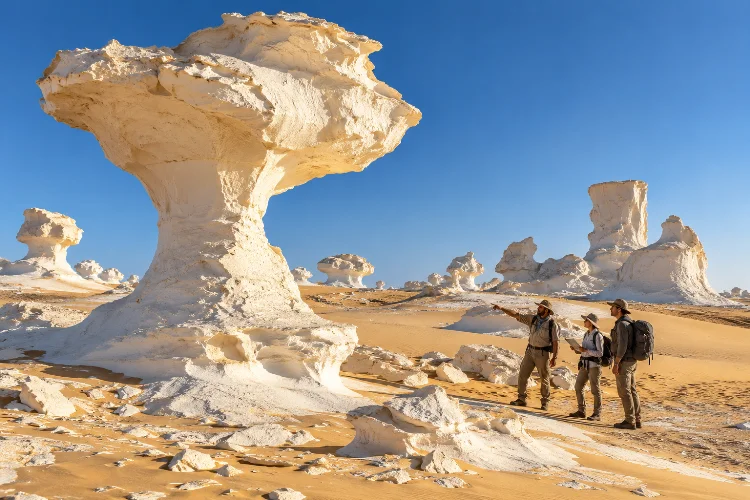
At first glance, Egypt’s White Desert looks less like a real landscape and more like a strange planet created for a science-fiction film. Brilliant white formations rise from golden sand, some shaped like mushrooms, towers, animals, or enormous pieces of abstract sculpture.
Yet the landscape becomes much more interesting once you stop seeing those rocks simply as unusual photo opportunities.
Exploring Egypt’s White Desert through guided geological expeditions reveals a much longer story involving ancient seas, Late Cretaceous chalk, changing climates, underground caves, erosion, fossils, and millions of years of landscape evolution.
The White Desert Protected Area was officially declared in 2002 and covers about 3,133.5 square kilometres. Egyptian environmental authorities describe it as an open-air location for studying desert environments, geology, fossils, karst features, and wildlife.
A knowledgeable guide can therefore turn a desert safari into something closer to a travelling geology lesson – without losing the adventure.
Understand Why the Desert Is Actually White
The first geological question is also the most obvious: why is this desert white?
Much of the Farafra Depression is covered by pale chalk belonging to the Khoman Formation. Geological research identifies these deposits as largely Late Cretaceous in age, with the snow-white chalk representing sediments that originally accumulated in an ancient marine environment.
That means the landscape you are driving across today once had a completely different setting.
Microscopic fossils, including marine foraminifera, have helped researchers reconstruct those ancient conditions. The chalk gradually became exposed after enormous environmental and geomorphological changes transformed the region into the arid Western Desert seen today.
This is where having a geolgical guide becomes valuable. The brilliant white ground stops being simply “desert rock” and becomes evidence of vanished seas, sedimentation, uplift, erosion, and climate change.
Even small fragments can reveal part of that story.
Learn How the Famous Chalk Sculptures Formed
The White Desert is best known for its strange freestanding formations.
Some resemble giant mushrooms. Others look like columns, cones, towers, or oversized animals depending on your imagination and viewing angle.
It is tempting to say they were created entirely by wind erosion, but the real explanation is more complicated.
Egypt’s environmental authorities describe chalk stacks produced through weathering and wind action, while geological research also identifies important karst and paleokarst processes throughout the region.
Joints in the chalk provided weak zones that weathering could exploit, leaving harder sections standing after softer material disappeared.
A guided expedition can help you notice those differences.
Instead of photographing the famous mushroom formations and driving away, examine layering, fractures, undercut bases, surface textures, and variations in resistance.
The shapes are not permanent monuments. They are part of an active landscape that continues to change.
Look for Evidence of a Wetter Ancient Climate
Perhaps the biggest surprise in the White Desert is discovering that its geology records conditions very different from today’s extreme dryness.
Researchers have documented ancient karst surfaces and cave systems created when the climate was considerably wetter. Some formations preserve evidence of old caves that have since lost their roofs through erosion, exposing features that originally developed underground.
This changes how you read the desert.
A dry depression that now receives little rainfall may preserve structures produced by groundwater, dissolution, flowing water, and much wetter prehistoric climates.
Geologists sometimes describe this as paleokarst—karst terrain inherited from an earlier environmental period rather than formed entirely under present-day conditions.
A good guide can point out old cave features or unusual limestone surfaces that would otherwise look like random weathered rock.
This is one reason a specialist expedition feels very different from a basic sightseeing safari.
Add Crystal Mountain to the Geological Route
Many Western Desert itineraries combine the White Desert with Crystal Mountain, located along the route between Bahariya and Farafra.
Despite the romantic name, it is not simply a mountain made from quartz crystals.
Recent geological research describes Gebel Crystal as an exposed or unroofed paleocave developed within chalky limestone of the Upper Cretaceous Khoman Formation. Calcite occurs throughout parts of the cave-fill sequence, creating the sparkling surfaces that gave the site its name.
Older tourism descriptions often simplify the geology, which makes this a particulary good stop for a knowledgeable guide.
The most useful question is not, “Where are the biggest crystals?” but, “Why did these minerals form here?”
Discussing groundwater movement, cavities, mineral deposition, cave development, and later erosion transforms Crystal Mountain from a quick photo stop into a compact field lesson.
And because these features are irreplaceable, observe them where they are rather than collecting pieces as souvenirs.
Compare the White Desert With the Black Desert
One of the most interesting ways to appreciate the White Desert is to compare it with the dramatically different landscape nearby.
Many guided routes through Egypt’s Western Desert combine the White Desert with the Black Desert, where isolated hills are covered in dark material rather than brilliant chalk.
Egyptian environmental authorities describe some of these darker hills as containing dolerite and iron-rich quartzite, while other formations include iron-rich sandstone and lighter limestone.
Visually, the contrast is immediate.
Geologically, it is even better.
Within the same broader Western Desert trip, you can move from white marine sedimentary rocks and chalk sculptures to dark hills, sand sheets, dunes, and different erosion patterns.
This comparison helps beginners understand a basic geological principle: deserts are not one type of landscape.
The Sahara contains enormously varied rock histories hiding beneath what may initially look like endless sand.
Choose a Guide Who Can Explain Geology, Not Just Drive
A 4×4 and a campsite do not automatically create a geological expedition.
When booking, ask what the guide actually knows about the landscape.
Can they explain the Khoman Formation? Do they understand the difference between modern wind erosion and older karst processes? Can they identify fossils without disturbing them? Do they know how Crystal Mountain formed?
You do not necessarily need a university professor accompanying the trip, but the operator should be able to provide meaningful interpretation rather than repeating names such as “Mushroom Rock” and “Chicken Rock.”
Egypt’s official tourism guidance recommends arranging excursions with specialized, licensed operators and checking current permits and regulations before entering remote desert areas. White Desert trips can range from single excursions to journeys lasting several nights.
For genuinely deep exploration, ask whether the schedule includes time for walking rather than moving continuously by vehicle.
Slow observation is where geology starts becoming visible.
Plan at Least One Night in the Desert
A day trip can introduce the landscape, but an overnight expedition provides more time to understand it.
During daylight, white chalk can appear almost painfully bright. Near sunset, those same formations begin reflecting gold, pink, and orange light, revealing textures that are difficult to notice at midday.
After dark, the experience changes again.
Without major urban lighting, the desert becomes dramatically quiet, and the surrounding formations turn into silhouettes beneath the night sky.
The Egyptian tourism authority notes that expeditions from the Farafra area can range from one to ten nights depending on whether travellers want to camp, hike, travel by 4×4, or explore more deeply.
A two-day or multi-day expedtion also gives your guide more freedom to discuss several environments rather than rushing between famous formations.
For trips lasting beyond two or three nights, official tourism advice recommends additional vehicle support for supplies and equipment.
Pack for Field Exploration, Not Just Photography
Geological exploration involves more time outside the vehicle than a conventional photo safari.
Comfortable walking shoes matter because chalk, gravel, sand, and uneven rock surfaces can all appear within the same day. Sun protection is essential, even when temperatures feel pleasant.
Carry sufficient water and dress for large temperature changes between daytime and night.
A notebook is surprisingly useful. Record the names of formations, sketch basic rock shapes, or write down geological questions rather than trying to remember everything later.
Binoculars can help examine distant cliffs without leaving established routes, while a camera with moderate zoom lets you document textures and layering without climbing fragile structures.
Avoid taking fossils, crystals, chalk fragments, or other geological material.
The White Desert is a protected landscape, and its scientific value depends on features remaining in their original context. Egyptian environmental authorities specifically highlight its fossils, geomorphology, archaeology, and distinctive chalk formations as reasons for protection.
Travel Responsibly Through a Fragile Landscape
Desert scenery can look indestructible because everything appears dry and rocky.
It isn’t.
Fragile chalk surfaces can break under climbing, while careless vehicle tracks may remain visible far longer than visitors expect. Fossil and mineral collecting also removes information from its original scientific context.
Use established routes where required and follow instructions from licensed local guides.
Camp in appropriate areas, remove waste, and avoid damaging formations for photographs. Do not assume that because a rock can support your weight once, climbing it causes no harm.
Responsible travel becomes even more important as the White Desert grows in popularity.
The area’s value comes precisely from its combination of spectacular scenery and unusually accessible geological evidence. Protecting both ensures future visitors can experience the same enviroment – and future researchers can continue learning from it.
Exploring Egypt’s White Desert through guided geological expeditions reveals a landscape far more complex than its famous mushroom-shaped rocks suggest.
Beneath the scenery lies a record of ancient seas, Late Cretaceous chalk deposition, marine fossils, paleokarst caves, wetter prehistoric climates, mineral formation, and millions of years of erosion.
A specialist guide helps connect those clues into one understandable story. Add places such as Crystal Mountain and the contrasting Black Desert, spend at least one night outside the cities, and allow enough time to walk rather than simply drive between viewpoints.
Before travelling, confirm current permits and access conditions with an authorized operator.
Then approach the White Desert as both an adventure destination and a natural geological archive. The landscape becomes much more impressive once you understand what you are actually looking at.
