Searching for a Nile cruise sounds simple until you open a few booking sites.
Suddenly, you are comparing “5-star standard,” “deluxe,” “premium,” “luxury,” “ultra-luxury,” boutique ships, dahabiyas, and several other labels that seem to mean slightly different things depending on who is selling the trip.
Understanding the differences between Nile cruise boat classes makes that process much easier. The important thing to know is that these marketing categories are not always applied through one universal consumer rating system.
Operators commonly create their own tiers based on cabin quality, food, service, ship condition, passenger numbers, and onboard facilities.
Most classic cruises operate between Luxor and Aswan, with sightseeing at places such as Karnak, Edfu, Kom Ombo, and Philae. What changes dramatically between classes is usually not the Nile itself, but how comfortably, privately, and slowly you experience it.
Don’t Trust the Class Name Alone
The first rule when comparing Nile cruises is simple: read beyond the label.
One operator’s “deluxe” vessel may offer newer cabins and excellent food, while another company’s similarly named ship may simply have slightly upgraded furnishings.
Terms such as standard, deluxe, luxury, and ultra-luxury are widely used by travel companies, but their definitions can vary.
This is why comparing two cruises only by star rating can be misleading.
Instead, look at the actual cabin size, refurbishment date, passenger capacity, dining format, number of decks, bathroom design, window type, swimming pool, Wi-Fi, elevator availability, and recent guest photographs.
Also check whether shore excursions, monument tickets, airport transfers, and Egyptologist guiding are included.
The better question is not, “Is this a luxury cruise?” It is, “What exactly am I getting for the higher price?”
Standard Nile Cruises Focus on Value
Standard-class cruises are usually aimed at travelers who care more about the archaeological itinerary than turning the boat into a resort.
You can generally expect a private cabin, en-suite bathroom, air conditioning, restaurant, sun deck, and basic communal facilities. Meals are commonly served buffet-style, and accommodation tends to be functional rather than highly personalized.
Cabins may be smaller and décor can feel dated on older vessels. The differences in upkeep can also be significant, so recent reviews matter particulary at this level.
The advantage is obvious: you still travel the same remarkable stretch of river.
Classic Nile cruises usually take around four to five days between Luxor and Aswan and include daily historical stops. If you plan to spend most daylight hours exploring temples and tombs, paying much more for an elaborate suite may not be necessary.
Standard boats therefore work well for budget-conscious travelers, first-time visitors, and people who see the vessel mainly as comfortable transportation between archaeological sites.
Deluxe Cruises Usually Offer the Best Middle Ground
Deluxe or superior vessels sit somewhere between practical standard boats and true high-end cruises.
This is often the most confusing category because improvements differ between ships. One vessel may offer significantly larger cabins, while another focuses on better food, newer interiors, or improved service.
Generally, you should expect more polished accomodation, better maintained public spaces, higher-quality bedding, and more appealing dining than on entry-level vessels.
Cabins may also have larger panoramic windows, although you should verify whether a “balcony” is a genuine outdoor balcony or simply a floor-to-ceiling sliding window.
For many travelers, deluxe is the sweet spot.
You receive enough comfort to make afternoons and evenings onboard enjoyable without paying top-tier prices for butler-style service or very large suites.
If your trip combines serious sightseeing with several hours of daily relaxation on deck, this middle class is often worth considering.
Luxury Cruises Make the Ship Part of the Vacation
On a genuine luxury Nile cruise, the vessel should feel like more than transportation.
Higher-end ships typically invest more heavily in interior design, cabin space, dining, service, and staff attention. Some include suites, spa facilities, gyms, larger pools, elegant lounges, and more sophisticated restaurant experiences.
Egypt’s official tourism portal describes luxury Nile cruises as full-board journeys with comfortable accommodation, Egyptian and international food, entertainment, sun decks, and guided sightseeing between Luxor and Aswan.
The biggest improvement may not always be something you can photograph.
Service quality matters. Smaller staff-to-guest ratios, more attentive housekeeping, better restaurant service, and smoother excursion logistics can make a significant difference over several days.
Luxury ships are a good fit for couples, honeymooners, milestone trips, and travelers who want afternoons onboard to feel as important as the morning temple visits.
Just remember that an expensive ship does not automatically produce a deeper archaeological itinerary. Check shore time seperately.
Ultra-Luxury Cruises Emphasize Space and Personal Service
Ultra-luxury is the top end of the conventional motor-cruise market, although the exact meaning again depends on the operator.
Expect fewer compromises.
Cabins may become substantially larger, sometimes shifting from ordinary rooms toward suites. Dining may include more refined menus or multiple venues, while décor, bedding, bathrooms, and public spaces are typically designed to compete with high-end hotels.
Some ships deliberately carry fewer passengers than their physical size could accommodate, creating a quieter atmosphere and more personalized service.
This level is best understood as experiential luxury rather than simply additional facilities.
You are paying for privacy, polish, space, and fewer small inconveniences.
However, examine the itinerary closely before assuming the highest-priced class is automatically the best choice.
Major Luxor-Aswan vessels often visit broadly similar headline archaeological sites, so upgrading usually improves life onboard more than it changes Karnak or Edfu.
For travelers who spend nearly all day ashore, ultra-luxury can therefore offer diminishing returns.
Dahabiyas Belong to a Different Kind of Class
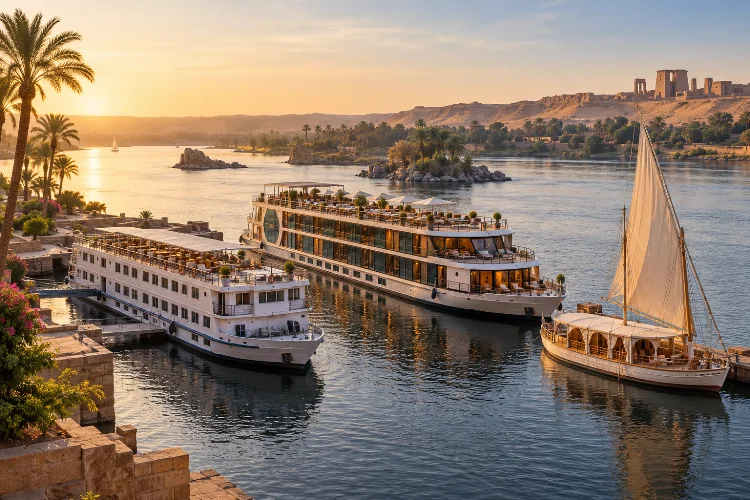
A dahabiya does not fit neatly into the standard-to-luxury ladder.
These traditional-style two-masted sailing boats are much smaller than conventional Nile cruise ships and focus on quiet travel, intimacy, and a slower relationship with the river.
Egypt’s official tourism site describes them as smaller, quieter vessels capable of stopping at villages, islands, and lesser-known archaeological locations that larger boats may not easily access.
Passenger numbers can be dramatically lower. Lonely Planet notes that many dahabiyas have only around four to ten cabins.
That changes everything.
Meals may be communal, the staff quickly learns everyone’s preferences, and there is far less anonymity than on a conventional cruise ship. The journey itself becomes a major part of the experience rather than simply the gap between monuments.
Because of their shallow draft and small size, some dahabiyas can also stop at quieter riverbanks or sites outside the standard cruise schedule.
Do not assume “traditional” means basic, either. Some dahabiyas are genuinely luxurious, with elegant cabins, private chefs, high-end furnishings, and private charter options.
Cabin Differences Matter More Than You Might Expect
A four- or five-night journey is long enough for cabin design to matter.
Start with the windows. Some older cruise vessels have smaller fixed windows, while newer ships may offer large panoramic glazing. Premium cabins sometimes include French-style windows or actual balconies.
Then look at location.
Lower-deck cabins can sit closer to engines or mechanical areas, while upper cabins may offer better views but potentially experience more activity from nearby communal spaces.
Ask specifically about noise.
Many cruise ships dock beside one another in Luxor or Aswan, so your beautiful river-view window may temporarily face the side of another boat rather than open water.
Bathroom quality is another major difference between classes. Entry-level ships may have compact shower areas, while higher categories tend to provide more generous layouts and better fixtures.
Recent cabin photos are often more useful than promotional descriptions.
Pay attention to maintanance too. A well-managed older vessel can be more comfortable than a newer ship with weak upkeep.
Dining and Service Often Reveal the Real Class Difference
Food is one of the easiest places to notice where extra money goes.
Standard ships typically rely heavily on buffets with a combination of Egyptian and international dishes. Deluxe vessels may improve the variety and presentation, while luxury cruises can introduce more restaurant-style service.
At the highest level, meals may become a genuine feature of the journey.
A dahabiya offers a different format again. With very few passengers, meals can feel closer to dining in a private house or boutique hotel than eating inside a large cruise restaurant.
Don’t judge food quality only by whether something is called a buffet or à la carte, though.
A good kitchen can produce excellent buffet meals, while a badly executed “gourmet” menu is still disappointing.
Recent reviews are extremely valuable here because food quality can change with chefs, management, and seasons.
Also check whether drinking water, coffee, soft drinks, and alcoholic beverages are included. Small extras can add significantly to the final bill.
Check Group Size and Excursions Before Upgrading
The ship class and the sightseeing experience are not necessarily the same product.
A luxury cabin is less meaningful if you spend every archaeological excursion in a crowded group and barely have time to explore.
Ask how many passengers normally travel with each Egyptologist.
Also check entrance fees carefully. Some cruise packages include guiding and transportation but not all monument tickets. Others bundle nearly everything into the fare.
A smaller excursion group can sometimes be a more valuable upgrade than moving from a deluxe cabin to a luxury suite.
If archaeology is your priority, consider spending your additional budget on private guiding, extra nights in Luxor, or specialist visits rather than automatically buying the highest boat class.
Classic cruisers generally follow relatively fixed schedules, whereas smaller dahabiyas can offer more flexibility and lesser-visited stops.
That distinction can have a bigger impact on your memories than marble in the bathroom.
Match the Class to Your Travel Style
Standard cruises make sense if you want good value and expect to spend most of your energy sightseeing.
Deluxe works well for travelers who want noticeably better comfort without making the ship the main attraction.
Luxury and ultra-luxury are worthwhile when spacious cabins, polished service, better dining, and elegant public spaces are major parts of the vacation.
A dahabiya suits a completely different personality: someone who enjoys slow travel, small groups, quiet decks, local landscapes, and a less rigid river experience.
There is no universally best class.
Even the official Egypt tourism site separates conventional Nile cruising and dahabiya sailing as distinct experiences rather than treating one simply as an upgraded version of the other.
Compare the specific ship, not the category name.
Understanding the differences between Nile cruise boat classes becomes much easier once you stop focusing on labels and start comparing what actually changes.
Standard boats emphasize value, deluxe ships improve comfort, luxury vessels make the onboard experience more important, and ultra-luxury cruises focus heavily on space, service, and refinement.
Dahabiyas follow another philosophy entirely, trading the scale of a floating hotel for smaller groups, slower sailing, and greater intimacy with the Nile.
Before booking, compare cabin dimensions, passenger capacity, dining, recent maintenance, excursion group size, inclusions, and actual itinerary time.
Then decide where your money matters most. Choose the class that matches how you travel – not simply the most impressive adjective in the brochure.