Ancient Egyptian pyramids can look almost timeless, as though their builders somehow discovered the perfect design and simply repeated it for centuries. The real story is much more interesting.
The famous smooth-sided pyramids at Giza were the result of generations of experimentation.
Egyptian architects moved from relatively simple rectangular tombs to stepped monuments, tested different pyramid angles, solved structural problems, developed sophisticated internal chambers, and eventually created complete funerary landscapes containing temples, causeways, and subsidiary tombs.
Understanding the architectural evolution of Egyptian pyramids therefore means looking beyond their size. Each generation of builders inherited ideas from earlier monuments, modified them, and occasionally made mistakes that became valuable lessons for later projects.
From Djoser’s revolutionary Step Pyramid to Sneferu’s engineering experiments and Khufu’s enormous monument at Giza, pyramid architecture records centuries of changing technology, religion, economics, and royal ambition.
Even when pyramids became smaller, their interiors and surrounding temples continued to evolve.
Before Pyramids: The Mastaba Tradition
Egyptian pyramid architecture did not begin with a triangular monument.
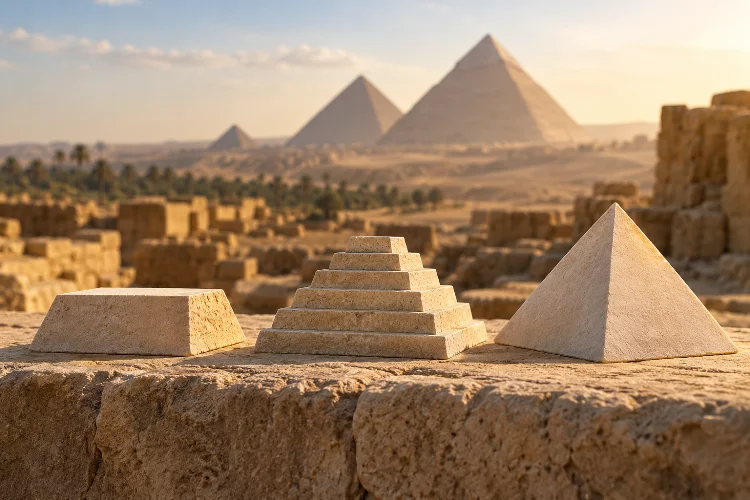
Before the Old Kingdom’s great pyramids appeared, Egyptian rulers and elites commonly used mastabas.
These were rectangular structures with flat roofs and sloping sides built above underground burial chambers. The name comes from the Arabic word for a bench because their shape resembles one.
The Egyptian Ministry of Tourism and Antiquities notes that mastabas were already used for royal and elite burials before the reign of Djoser.
Their importance is easy to underestimate. Mastabas established several concepts that later became central to pyramid complexes, including underground burial spaces, offering areas, funerary rituals, and the idea of creating an impressive structure above a royal tomb.
Architecturally, however, these tombs remained relatively horizontal. The breakthrough came when Egyptian builders began thinking vertically.
Djoser’s Step Pyramid Changed Everything
During the Third Dynasty, King Djoser transformed Egyptian royal burial architecture on an unprecedented scale.
His Step Pyramid at Saqqara, traditionally associated with the architect Imhotep, developed from the mastaba concept. Instead of constructing a single rectangular monument, builders effectively created a sequence of increasingly smaller mastaba-like levels stacked above one another.
The result was a six-step pyramid and one of the earliest monumental stone structures in Egypt.
This was far more than a cosmetic developement. Building upward required new knowledge about stone cutting, load distribution, foundations, construction organization, and the transportation of enormous quantities of material.
Djoser’s surrounding complex was equally innovative. Courtyards, ceremonial buildings, enclosure walls, underground spaces, and structures associated with royal rituals turned the tomb into a complete architectural environment.
The pyramid was no longer simply protecting a burial. It had become the visual center of royal power and eternal kingship.
Sneferu Turned Pyramid Building Into an Engineering Laboratory
The next major transformation came during the reign of Sneferu, the first king of the Fourth Dynasty.
Few rulers contributed more to the evolution of pyramid construction. His projects at Meidum and Dahshur show Egyptian architects actively experimenting with the transition from stepped pyramids to smooth-sided monuments.
At Meidum, construction began with a stepped design that was later transformed into a true pyramid by filling the steps and adding an outer surface.
The surviving structure looks very different today, but its construction phases provide important evidence of changing architectural methods.
Then came the extraordinary Bent Pyramid at Dahshur.
Builders initially used an angle of roughly 55 degrees. Structural concerns eventually forced them to reduce the upper section to around 43 degrees, creating the monument’s famous bent profile.
Rather than viewing it simply as a failed pyramid, it is better understood as visible evidence of architectural problem-solving.
The Red Pyramid Solved the Shape
Sneferu’s builders applied what they had learned to another project nearby.
The Red Pyramid at Dahshur successfully achieved the smooth-sided form that would soon define Egyptian pyramid architecture. It is also the third-largest pyramid in Egypt after the pyramids of Khufu and Khafre.
Its lower angle created a more stable mass than the original design attempted at the Bent Pyramid.
The transition from Meidum to the Bent Pyramid and finally the Red Pyramid represents one of the clearest sequences of structual experimentation in ancient architecture.
Giza Brought Pyramid Engineering to Its Peak
Sneferu’s experiments prepared the way for his successor Khufu.
At Giza, pyramid construction reached a scale that had never been achieved before. Khufu’s Great Pyramid originally stood about 146.5 metres high, making it the tallest human-made structure in the world for approximately 3,800 years.
Yet its height was only one architectural achievement.
The pyramid includes multiple internal chambers, including the King’s Chamber high within the masonry and the enormous Grand Gallery. The core was constructed mainly from local limestone, while high-quality Tura limestone originally covered the exterior.
During the Fourth Dynasty, the overall layout of royal pyramid complexes also became increasingly standardized.
A typical arrangement included the pyramid, a mortuary temple beside it, a long causeway, and a valley temple closer to the cultivated Nile Valley. Queens’ pyramids, mastaba cemeteries, boat pits, and other structures could surround the central royal monument.
This is why Giza should not be understood as three giant geometric objects sitting independently in the desert. Each pyramid formed the center of a much larger religious and ceremonial system.
Khafre and Menkaure Shifted Architectural Priorities
Khufu’s successors did not simply attempt to build something larger.
Khafre’s pyramid is slightly smaller than the Great Pyramid, although its position on higher ground makes it appear almost equal in height from some viewpoints. His wider complex also demonstrates increasing attention to monumental temples and ceremonial architecture.
Menkaure took the trend further.
His pyramid is considerably smaller than those of Khufu and Khafre, yet part of its casing used granite transported from Aswan. His associated temples were also proportionally significant.
Egypt’s Ministry of Tourism and Antiquities interprets this as part of a gradual shift in emphasis from the sheer size of the royal tomb toward the royal funerary cult conducted around it.
That distinction matters.
Architectural evolution does not always mean buildings becoming larger. Sometimes it means resources being redirected toward different functions.
Smaller Pyramids Became More Symbolically Complex
By the Fifth and Sixth Dynasties, royal pyramids were generally smaller than the gigantic Fourth Dynasty monuments.
That does not mean Egyptian architecture had suddenly become primitive.
Instead, religious symbolism became increasingly visible within the structures and their surrounding temples. One of the best examples is the Pyramid of Unas at Saqqara, built near the end of the Fifth Dynasty.
Although relatively small, it contains the earliest known example of the Pyramid Texts. These religious spells were inscribed across the burial chamber and other internal walls to help the dead king reach the afterlife.
Architecture and sacred writing were now working together.
Later pyramids could also use smaller blocks and rubble-filled cores rather than the enormous, carefully arranged masonry seen in earlier monuments.
The Sixth Dynasty pyramid of Teti, for example, used a core of relatively small local limestone blocks and debris covered by finer casing stone. Once much of that casing disappeared, the weaker core deteriorated considerably.
This helps explain why some later pyramids resemble natural hills today.
Middle Kingdom Pyramids Reinvented an Old Tradition
Large-scale pyramid construction declined after the Old Kingdom, but the architectural idea did not disappear.
During the Middle Kingdom, rulers returned to pyramid complexes while adapting them to different economic, technological, and religious conditions.
Sites such as Lisht and Dahshur became important royal cemeteries. At Dahshur, for example, Middle Kingdom rulers including Senwosret III and Amenemhat III built new pyramid complexes close to monuments that were already centuries old.
The scale and organization of surrounding temples also changed. Research on Senwosret III’s pyramid complex indicates that Dynasty 12 pyramid temples became smaller as religious ideas concerning royal burial and the afterlife evolved.
Middle Kingdom architecture therefore represents adaptation rather than simple decline.
Egyptian builders were no longer trying to reproduce the Great Pyramid.
They were reinterpreting the pyramid concept for a different political and religious world, often combining traditional forms with new construction techniques and more complex security arrangements inside royal tombs.
Pyramid Evolution Was About More Than Engineering
It is tempting to describe pyramid history as a straightforward technological progression: builders started with mastabas, invented steps, perfected smooth sides, and eventually created Giza.
Reality was more complicated.
Architecture reflected royal authority, religious beliefs, available labour, materials, construction knowledge, burial traditions, and changing ideas about the afterlife.
The enormous Fourth Dynasty pyramids appeared during a period when Egyptian kings could mobilize remarkable resources. Later rulers did not necessarily lack engineering knowledge simply because their pyramids were smaller.
Sometimes religious texts became more important. In other periods, temples received greater architectural attention. Construction materials and internal layouts also changed according to practical needs.
The evolution of pyramids was therefore both technical and cultural – a continous conversation between tradition and innovation lasting many centuries.
Understanding the architectural evolution of Egyptian pyramids reveals that Giza was not the beginning of the story and certainly not the entire story.
The journey started with mastaba tombs, accelerated dramatically with Djoser’s Step Pyramid, and passed through Sneferu’s remarkable experiments before reaching the engineering sophistication of Khufu’s Great Pyramid.
Later builders changed the formula again. Pyramids became smaller, temples evolved, funerary texts appeared inside royal chambers, and Middle Kingdom architects adapted old traditions to new circumstances.
Looking at this progression makes every pyramid more interesting because even unusual shapes and apparent failures become part of a larger architectural experiment.
If you’re exploring ancient Egypt, consider visiting Saqqara, Meidum, Dahshur, and Giza together. Seeing the monuments in chronological order is one of the best ways to understand how Egyptian pyramid building actually evolved.