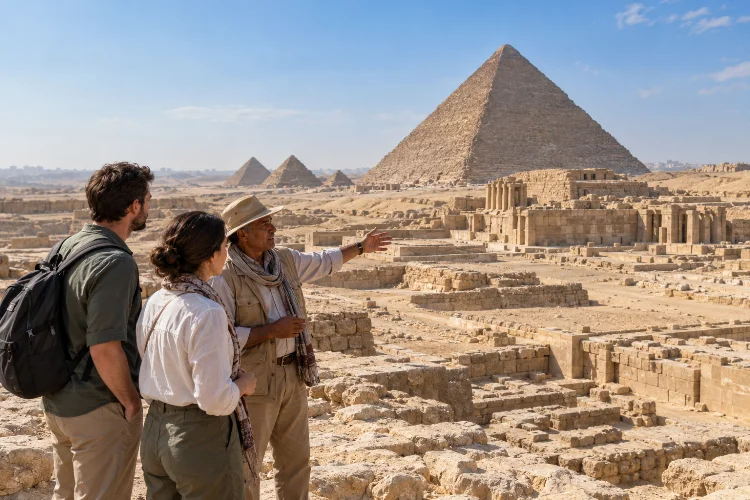
Visiting Giza can be as simple as seeing the Great Pyramid, taking a photograph with the Sphinx, and heading back to Cairo. But if ancient Egypt genuinely interests you, that approach barely scratches the surface.
An in-depth archaeological visit to Giza Pyramids requires looking at the plateau as a complete ancient landscape.
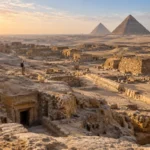
The three enormous royal pyramids were surrounded by temples, causeways, queens’ pyramids, mastaba cemeteries, boat pits, workers’ areas, and smaller monuments connected to the royal funerary system.
Egypt’s Ministry of Tourism and Antiquities describes each royal pyramid as only one element within a much larger complex. Planning ahead therefore makes a huge difference.
Instead of randomly moving between famous viewpoints, you can follow the development of Fourth Dynasty architecture, understand who was buried around the kings, and recognize how temples and tombs worked together.
The result is a slower visit, but also a far more memorable one.
Understand Giza Before You Arrive
Start your preparation before reaching the plateau.
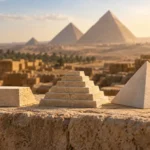
The three main pyramids belong to kings of Egypt’s Fourth Dynasty. Khufu built the Great Pyramid, while the other major pyramids belonged to Khafre and Menkaure.
The Great Pyramid originally stood about 146.5 metres high and remained the world’s tallest structure for roughly 3,800 years.
Knowing that basic chronology immediately makes the site easier to read.
Khafre’s pyramid, for example, may appear almost as large as Khufu’s because it stands on higher ground. It also preserves some polished casing stone near its upper section. Khafre’s complex includes substantial remains of his mortuary temple, causeway, and valley temple.
Menkaure’s pyramid is much smaller, originally around 65 metres tall, but its lower casing incorporated granite transported from Aswan, more than 800 kilometres away. That detail alone shows why size is not the only interesting measurement at Giza.
A little background research turns piles of stone into understandable architecture.
Give Yourself More Than a Quick Half-Day Tour
One of the biggest planning mistakes is assuming Giza can be studied properly in two or three hours.
Technically, you can see the major landmarks quickly. Archaeologically, however, you will constantly feel rushed. The plateau includes pyramid complexes, mastaba cemeteries, temple remains, subsidiary structures, tombs, and viewpoints spread across a large desert landscape.
For a serious visit, reserve most of a day. Arriving close to opening time also gives you more flexibility before the site becomes busier and the desert heat intensifies.
The Ministry currently lists a separate general admission ticket for the Giza Plateau, while entry to places such as the Great Pyramid, certain other pyramids, the Tomb of Meresankh III, and the workers’ cemetery may require additional tickets.
Prices and opening arrangements can change, so verify them through the official site shortly before travelling.
Don’t build your schedule around an old travel blog from several years ago. Archaeological sites can close occassionally for conservation or restoration.
Begin With Khufu’s Pyramid Complex
The Great Pyramid is the logical starting point because it provides the foundation for understanding the rest of Giza.
Before entering it, spend a few minutes looking at the structure from outside. Notice the enormous limestone blocks, the position of the entrance, surrounding foundations, and the remains of structures around the pyramid.
Inside, the experience is surprisingly different from what some first-time visitors expect. There are no walls covered with colourful hieroglyphs. Instead, the architecture itself is the attraction.
The interior includes passages, chambers, and the impressive Grand Gallery leading toward the King’s Chamber. The royal sarcophagus still remains inside.
Entering is physically demanding for some visitors because passages can be narrow, steep, warm, and crowded. If you dislike confined spaces, you can still understand the pyramid extremely well from its exterior architecture and surrounding complex.
Allowing time for both perspectives is better than rushing inside simply to say you did it.
Explore the Eastern and Western Cemeteries
The mastaba cemeteries around Khufu’s pyramid are among the best places to move beyond conventional sightseeing.
The Eastern and Western Cemeteries contain tombs belonging to royal relatives and some of the most important officials of the Old Kingdom.
The Eastern Cemetery was especially associated with members of Khufu’s family, while the Western Cemetery contains an orderly grid of mastabas belonging largely to high-ranking nobles.
This layout tells you something important about ancient Egyptian society. A person’s burial location could reflect proximity to royal power.
One particularly significant figure associated with the Western Cemetery is Hemiunu, an elite official linked with overseeing construction of the Great Pyramid. Around the Eastern Cemetery, meanwhile, archaeologists found burials connected with members of Khufu’s family.
When walking through these areas, don’t expect another giant monument. Their value is subtler.
Look at tomb orientation, masonry, chapel spaces, shafts, and how closely each mastaba sits relative to the king’s complex. This quieter enviroment often provides more archaeological context than the main panoramic viewpoints.
Add at Least One Decorated Tomb
If an accessible decorated tomb is open during your visit, make it a priority.
The Tomb of Queen Meresankh III is an excellent example. Meresankh III was a granddaughter of Khufu and wife of Khafre, and her tomb contains remarkably preserved relief decoration.
Scenes show bread making, beer production, herding, bird hunting, mat making, metalworking, statue carving, servants, and offerings. Rather than simply presenting monumental royal architecture, these images offer glimpses of activities that supported elite life and funerary beliefs.
One striking section contains a series of female statues carved directly from the rock wall.
Visiting a decorated tomb after seeing the Great Pyramid creates a useful contrast. Khufu’s pyramid communicates royal power through monumental engineering; a mastaba chapel can reveal social relationships, craft production, clothing, offerings, and beliefs through visual detail.
Check ticket availability seperately before your trip, because special tomb admission may not be included with general plateau access.
Trace Khafre’s Causeway to the Sphinx
Don’t treat the Great Sphinx as an isolated sculpture.
Its archaeological context becomes much clearer when you study Khafre’s pyramid complex as a connected route. Khafre’s mortuary temple stood beside his pyramid, while a causeway descended toward the valley temple near the Sphinx.
The Ministry notes that the Sphinx was carved directly from the limestone bedrock and that archaeological evidence associates it with Khafre’s reign. The Sphinx Temple sits beside Khafre’s valley temple and the lower section of the causeway.
Walking through this area with that relationship in mind is far more revealing than simply searching for the prefered photo angle.
Look at how the pyramid, causeway, temples, and Sphinx line up across the terrain. You begin to see the site as ceremonial infrastructure designed around royal burial and cult activity.
This spatial relationship is one of the most important things to understand at Giza.
Don’t Ignore Menkaure’s Smaller Complex
After Khufu and Khafre, travellers sometimes treat Menkaure’s pyramid as an optional third stop.
For archaeology enthusiasts, that would be a mistake.
Its smaller scale allows architectural differences to become more obvious. Menkaure used granite for part of the pyramid’s exterior casing, creating a different construction challenge from the predominantly limestone pyramids of his predecessors.
Nearby subsidiary pyramids also help demonstrate that royal pyramid complexes contained much more than the king’s main tomb.
From this part of the plateau, step back and observe all three main pyramids in relation to one another. The landscape makes it easier to understand how successive rulers occupied different parts of the same necropolis.
Photography is useful here, but spend some time without a camera too. Looking at the differences in elevation, casing materials, scale, and surrounding structures can reveal details that disappear when you’re only searching for a composition.
Study the People Who Built and Supported Giza
A deeper archaeological visit should include more than kings.
Evidence from settlements, cemeteries, workshops, food production, administration, and labour organization has helped researchers reconstruct the human systems behind pyramid building.
Giza was not simply an empty desert where thousands of workers suddenly appeared.
The wider World Heritage property contains temples, tombs, settlements, and other remains that document ancient Egyptian life. UNESCO notes that the Memphis necropolis contains thousands of rock-cut tombs in addition to its famous pyramids.
Thinking about labour also changes the questions you ask while visiting.
How were workers fed? Where did administrators operate? How were materials transported? Why were specific cemeteries placed where they were?
These questions make the plateau much more interesting than endless speculation about how heavy stones were moved.
If workers’ areas or special archaeological sections are accessible during your visit, follow official visitor routes rather than attempting to enter restricted excavation zones.
Bring the Right Tools for a Serious Visit
You don’t need professional archaeological equipment, but a little preparation helps enormously.
Download or save a map of the plateau before arriving. Keep a short chronology of Khufu, Khafre, and Menkaure on your phone, along with notes about the tombs or architectural features you most want to identify.
A notebook can also be surprisingly useful. Write down questions while exploring rather than trying to memorize everything.
Bring water, sun protection, comfortable walking shoes, and clothing suitable for heat and dusty conditions. Distances that seem short on a map can feel much longer under direct desert sun.
If photography matters to you, wider focal lengths work well around enormous monuments, while modest zoom capability helps isolate casing stones, temple masonry, and distant architectural relationships.
Most importantly, stay within marked visitor areas. Archaeological remains that look like ordinary stone foundations can be fragile and scientifically important.
Connect Giza With the Wider Memphis Necropolis
For travellers with several days available, Giza becomes even more meaningful when placed within Egypt’s broader pyramid-building history.
UNESCO’s World Heritage designation covers the pyramid fields extending from Giza toward sites including Saqqara and Dahshur.
The wider region preserves the development of Egyptian funerary architecture from mastaba forms toward increasingly sophisticated pyramids.
Seeing earlier structures at Saqqara or Dahshur can help explain why Khufu’s Great Pyramid represents such an extraordinary architectural achievement.
In other words, Giza works best as part of a story rather than an isolated attraction.
If you’re especially interested in archaeology, consider dedicating seperate days to Giza and the southern pyramid fields rather than compressing everything into one rushed tour.
Planning an in-depth archaeological visit to Giza Pyramids means looking beyond the famous silhouettes.
Give yourself enough time to study Khufu’s complex, explore the mastaba cemeteries, enter a decorated tomb when possible, trace Khafre’s temples and causeway, examine Menkaure’s architecture, and think about the communities that supported these royal projects.
The most rewarding Giza visit is not necessarily the one where you see the greatest number of attractions. It is the one where the landscape begins to make sense.
Before travelling, review the latest official opening hours, ticket rules, and monument access, then build your route around the archaeological subjects that interest you most. Arrive curious, move slowly, and Giza becomes far more than a pyramid photo stop.