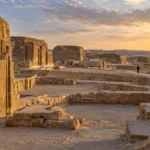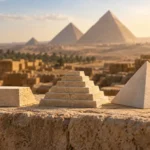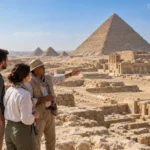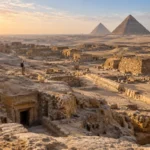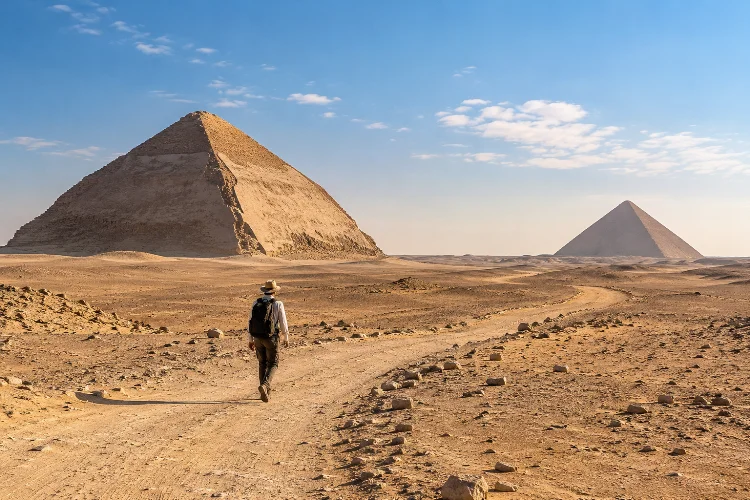
Egypt’s most famous pyramids may stand at Giza, but one of the best places to understand how pyramid building actually evolved is farther south at Dahshur.
Here, the desert landscape is quieter, the crowds are generally less intense, and two extraordinary monuments stand only about a kilometre apart.
Learning how to visit Dahshur’s Bent and Red Pyramids in a single day is fairly straightforward, but a little preparation makes the experience much better.
Both pyramids were built for Pharaoh Sneferu during the Fourth Dynasty, and together they capture a crucial moment when Egyptian architects were figuring out how to move from stepped monuments toward the smooth-sided pyramid form later perfected at Giza.
A day at Dahshur can include exterior exploration, photography, archaeological context, and – when access is operating – an intense journey inside the pyramids themselves. The key is arriving early and resisting the temptation to rush.
Why Dahshur Deserves a Full Day Trip
Dahshur formed part of the vast necropolis associated with ancient Memphis. Its archaeological landscape contains monuments from both the Old and Middle Kingdoms, including the Bent Pyramid, Red Pyramid, Black Pyramid, and several later royal complexes.
The site is particularly important because it preserves evidence of the transition toward the classic pyramid shape.
Sneferu’s Bent Pyramid shows that ancient Egyptian engineering developed through experimentation rather than appearing fully formed.
The Red Pyramid nearby represents a much more successful smooth-sided design and became an important architectural predecessor to the pyramids at Giza.
Egypt’s official tourism site even describes Dahshur as a key place for seeing this progression in pyramid-building techniques.
That makes visiting both on the same day feel less like seeing two similar monuments and more like walking through two stages of the same engineering story.
Get to Dahshur Early
For most independent visitors staying in Cairo or Giza, arranging a private car, taxi, or driver is the simplest option.
Dahshur sits south of central Cairo, and return transportation is worth organising in advance rather than assuming a car will always be waiting near the archaeological entrance.
Try to reach the site close to opening time.
The official Ministry of Tourism and Antiquities listing currently shows Dahshur open from 8:00 AM to 5:00 PM daily.
It also lists general site admission for foreign adults at EGP 200 and students at EGP 100, although Egyptian archaeological ticket prices can change, so check the official page shortly before travelling.
An early arrival also means cooler conditions and better light. The plateau is exposed, and even relatively short walks can feel much longer under strong midday sun.
Bring water, a hat, sunscreen, and shoes suitable for dusty, uneven ground.
Visit the Bent Pyramid First
Starting with the Bent Pyramid makes historical sense because it represents the earlier stage in Sneferu’s Dahshur experiments.
Its unusual shape is immediately obvious. Construction began at an angle of about 55 degrees, but the upper part was reduced to roughly 43 degrees after builders encountered structural problems associated with the original design.
That change gives the monument its famous bent silhouette.
Instead of viewing it as an architectural failure, think of it as a full-scale engineering experiment. Egyptian builders were working with an unprecedented volume of stone while still learning how steep a smooth-sided pyramid could safely be.
Walk Around Before Going Inside
Give yourself time to examine the pyramid from several angles before considering the interior.
One remarkable feature is the survival of significant areas of smooth outer casing. This gives the Bent Pyramid a very different appearance from many later Egyptian pyramids whose casing stones were largely removed.
The structure also has two entrances, one on the north side and another high on the western face. These lead to seperate internal chamber systems with dramatic corbelled ceilings.
If interior access is available, expect a physical experience rather than an easy museum walk.
Egypt’s official tourism portal describes the route as involving a narrow tunnel of around 80 metres leading toward chambers deep inside the structure.
People with strong claustrophobia, knee problems, heart conditions, or difficulty crouching may prefer to appreciate the pyramid from outside.
Continue North to the Red Pyramid
After the Bent Pyramid, continue toward the Red Pyramid, located roughly one kilometre away.
This is where Sneferu’s architectural story becomes even more interesting.
The Red Pyramid was constructed using a shallower angle and became a successful smooth-sided pyramid. It is also the third-largest pyramid in Egypt after the pyramids of Khufu and Khafre at Giza.
Its modern name comes from the reddish colour of its exposed limestone blocks. Originally, however, the monument was covered in bright white Tura limestone casing, much of which was later removed and reused elsewhere.
Standing back from the structure is worthwhile because its relatively low slope can make its enormous scale difficult to appreciate up close.
Once you compare it directly with the Bent Pyramid, the design changes become obvious. The transition is almost like seeing ancient Egyptian engineers revise one giant prototype and then build a more stable version.
Decide Whether to Enter the Red Pyramid
The Red Pyramid offers one of Dahshur’s most memorable interior experiences.
Its entrance sits on the northern side and leads into a descending corridor approximately one metre high and one metre wide. Visitors then reach a sequence of chambers with impressive corbelled ceilings before reaching a third chamber generally interpreted as the burial chamber.
The route can be demanding.
You may spend a significant amount of time bent forward while moving through the passage. The interior can also feel warm, enclosed, and physically tiring, especially after exploring the Bent Pyramid.
If you plan to enter both monuments, leave enough recovery time between them.
There is no prize for moving quickly. Sit outside, drink water, and enjoy the desert enviroment before tackling another narrow passage.
For archaeology enthusiasts, the interior is especially useful because it reveals how builders were experimenting not only with exterior pyramid geometry but also with chamber placement and load management.
Leave Time for the Wider Dahshur Landscape
It is easy to focus entirely on Sneferu’s two giant monuments, but Dahshur contains more than the Bent and Red Pyramids.
Middle Kingdom kings later returned to the area. The necropolis includes pyramids associated with Amenemhat II, Senwosret III, and Amenemhat III, whose badly eroded monument is commonly known as the Black Pyramid.
Many of these structures cannot be explored like the two main pyramids, but they are still valuable when reading the landscape.
From suitable viewpoints, notice how different monuments occupy the edge of the desert near the cultivated Nile Valley.
Dahshur was not an isolated collection of tombs; it belonged to the much larger Memphite funerary landscape extending through Saqqara and ultimately toward Giza.
UNESCO’s World Heritage property encompasses the pyramid fields from Giza to Dahshur and preserves the long evolution of royal tomb architecture from mastabas to monumental pyramids.
That wider context turns a simple day trip into an archetectural history lesson.
Use a Simple One-Day Schedule
A relaxed Dahshur visit works best when you avoid packing too much into the same day.
Aim to arrive around 8:00–8:30 AM and spend the first part of the morning at the Bent Pyramid. Explore its exterior carefully and enter only if you are comfortable with confined passages.
By late morning, move toward the Red Pyramid.
Allow roughly one to two hours around the Red Pyramid depending on photography, interior access, and how slowly you want to explore. Afterwards, spend some time taking wider landscape photographs or observing the more distant Middle Kingdom monuments.
Leaving Dahshur sometime in the early afternoon keeps the trip comfortable.
You could technically combine Dahshur with Saqqara on the same day, but doing so changes the character of the experience. If your goal is detailed archaeology rather than checking monuments off a list, giving each major necropolis more time is usually more rewarding.
Photography Tips for Both Pyramids
Dahshur is especially good for wide landscape photography because the monuments often feel less visually crowded than those at Giza.
Morning light is generally easier to work with and can reveal texture in the limestone blocks. Rather than photographing every pyramid directly from the front, walk along authorised visitor areas and use the desert foreground to emphasize scale.
The Bent Pyramid works particularly well from a slight angle where its change in slope becomes unmistakable.
At the Red Pyramid, move farther away if possible. Its broad base can overwhelm a frame when photographed from too close.
Avoid climbing on ancient masonry or crossing barriers for a better photograph. Many areas that look like ordinary piles of stone are archaeologically sensitive.
Prepare for Desert Conditions and Restricted Spaces
Dahshur is not a difficult destination, but comfort depends heavily on preparation.
Wear breathable clothing and sturdy shoes. Carry more water than you think you will need, especially outside the cooler winter months.
Inside the pyramids, a small backpack can become annoying because of the low passages. Keeping your belongings compact makes moving much easier.
It is also sensible to check opening conditions shortly before your trip. Archaeological interiors can occassionally close because of maintenance, conservation, safety inspections, or operational changes.
Never build an entire visit around guaranteed access to a particular chamber. The exteriors and wider landscape are already worth the trip.
Why Visiting Both Pyramids Matters
Seeing only one of Sneferu’s Dahshur pyramids means missing half of the story.
The Bent Pyramid captures architects adapting their design while construction was already underway. The Red Pyramid shows the solution that followed: a stable smooth-sided structure built with a gentler slope.
That progression helped establish the knowledge later used during the great pyramid-building era at Giza.
Egypt’s Ministry of Tourism and Antiquities specifically identifies the Red Pyramid as Egypt’s first completed true pyramid and an important step toward the perfected pyramid form.
Few archaeological sites make technological development this visible.
You can literally move from the experiment to the solution within the same morning.
Knowing how to visit Dahshur’s Bent and Red Pyramids in a single day allows you to experience one of ancient Egypt’s most important architectural stories without rushing.
Start early with the Bent Pyramid, study its dramatic change in angle, then continue to the Red Pyramid to see how Sneferu’s builders transformed those lessons into a successful smooth-sided design.
Leave plenty of time for the interiors if they are open, but don’t underestimate the value of simply walking around the monuments and studying them from a distance.
Before travelling, confirm current ticket prices and access through official Egyptian sources, arrange reliable return transport, and prepare for desert conditions.
If you want to understand how Egypt went from early pyramid experiments to the engineering achievements of Giza, Dahshur belongs near the top of your itinerary.