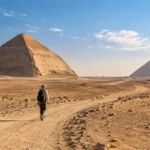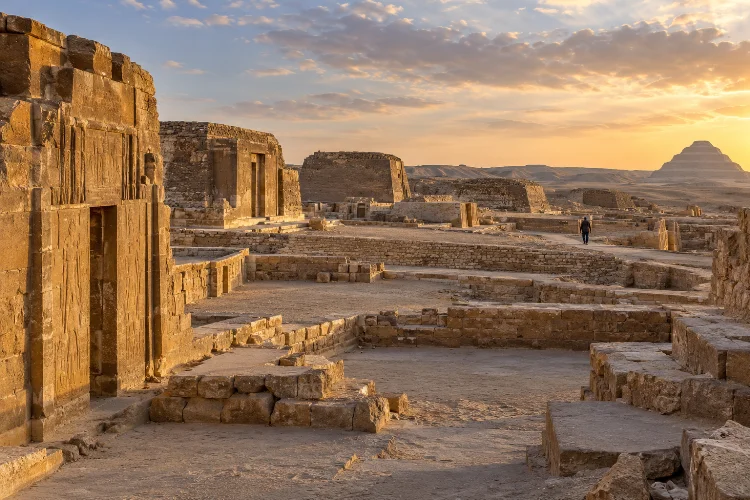
Saqqara is often introduced with a single image: the distinctive stepped silhouette of Djoser’s pyramid rising above the desert.
It deserves the attention, but focusing only on that monument is a little like visiting an enormous museum and stopping after the entrance hall.
Located roughly 40 kilometres southwest of Cairo, Saqqara served as one of the principal cemeteries of ancient Memphis.
Its monuments span an extraordinary period of Egyptian history, from burials associated with the earliest dynasties through the Old and New Kingdoms and into later eras. The site even preserves evidence from Egypt’s Coptic period.
Exploring the Saqqara Necropolis and its lesser-known monuments therefore means moving beyond the obvious pyramid viewpoint.
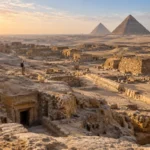
Hidden among its sandy landscape are decorated mastabas, underground galleries for sacred bulls, royal funerary texts, unusual temple-tombs, and structures that reveal how Egyptian ideas about death changed over thousands of years.
Start With Djoser, but Look Beyond the Pyramid
The Step Pyramid of Djoser remains the natural starting point. Built during Egypt’s Third Dynasty, it represents one of the great turning points in ancient architecture.
Earlier royal and elite tombs generally took the form of mastabas, while Djoser’s monument developed into a six-step structure rising dramatically above its surrounding complex.
What visitors sometimes miss is that the pyramid was only one element of an enormous ceremonial landscape.
Courtyards and symbolic buildings around it were connected with rituals such as the Sed Festival, which renewed the king’s authority. Some structures were essentially stone versions of temporary ceremonial buildings, preserving them permanently for the ruler’s afterlife.
Spending time around these surrounding spaces makes the site far more understandable. Djoser’s complex was not simply a giant tomb; it was an architectural recreation of royal power.
Descend Into the Mysterious Southern Tomb
One of Saqqara’s more unusual monuments sits within Djoser’s own funerary complex.
The Southern Tomb contains both an above-ground structure and a deep underground system.
Its burial chamber lies at the bottom of a shaft roughly 31 metres deep, while corridors preserve decorative features including blue faience tiles and reliefs showing Djoser participating in royal rituals.
Its precise purpose remains debated.
One interpretation suggests that it functioned as a symbolic second burial for Djoser, possibly connected with his role as ruler of Upper and Lower Egypt.
Other explanations have been proposed over time, which makes the monument particulary interesting because archaeology does not always provide one neat answer.
For visitors who enjoy architecture, the Southern Tomb offers something the Step Pyramid’s exterior cannot: a closer sense of the complicated subterranean spaces hidden beneath Saqqara.
Discover the Pyramid Texts Inside the Pyramid of Unas
From the outside, the Pyramid of Unas hardly competes with the scale of Giza.
Its importance becomes clear once you understand what appeared inside it. Unas, the final ruler of Egypt’s Fifth Dynasty, had funerary spells carved across the walls of his burial apartments.
These inscriptions represent the earliest known appearance of what Egyptologists call the Pyramid Texts.
Their purpose was essentially supernatural assistance.
The spells helped the deceased ruler navigate the afterlife, join the gods, and overcome the dangers associated with death. Similar religious ideas continued evolving in later Egyptian funerary traditions.
Parts of Unas’s wider complex also survive. His mortuary and valley temples were connected by a decorated causeway, fragments of which can still be seen.
It is a perfect example of why the physically smaller monuments of Saqqara can carry enormous historical significance.
Enter the Remarkable Mastaba of Mereruka
Royal pyramids naturally dominate conversations about Saqqara, but elite mastaba tombs can offer a much more personal look at ancient Egyptian society.
The Tomb of Mereruka is one of the best examples.
Mereruka served as vizier during the reign of Teti and married one of the king’s daughters. His enormous mastaba contains around 30 rooms, including areas associated with his wife and son, reflecting the exceptional status of his family.
Its decorated walls are the real attraction.
Scenes show cattle herding, fishing, bird hunting, hippopotamus harpooning, and other activities. A striking statue of Mereruka appears to step forward from a false door, symbolically ready to receive offerings.
These images remind visitors that Egyptian tomb decoration was not simply ornamental. Agriculture, food production, hunting, family, servants, and ritual were incorporated into a carefully designed vision of eternal life.
Find Everyday Life in the Tomb of the Two Brothers
Another fascinating Old Kingdom monument belongs to Niankhkhnum and Khnumhotep.
The two men were Fifth Dynasty officials connected with the royal court and the sun temple of King Nyuserra. They held unusual titles related to royal grooming, including responsibilities associated with the king’s hairdressers and manicurists.
Their shared tomb contains vivid scenes of farming, hunting, animal slaughter, jewellery production, and sculpture.
The best-known image depicts the two men closely embracing. Their relationship has generated considerable modern discussion, although interpretations have changed as scholars have continued examining the evidence.
The Egyptian Ministry’s presentation notes recent research suggesting that they may have been identical twins.
Whatever interpretation you prefer, the tomb demonstrates how much information can survive in an apparently modest structure.
This is the kind of monument that transforms an archaeolgical visit from a tour of famous buildings into a study of real individuals.
Walk Through the Underground Serapeum
Few monuments at Saqqara feel as atmospheric as the Serapeum.
Rather than serving a human ruler, this underground complex became the burial place of sacred Apis bulls, animals closely associated with Ptah, the major god of nearby Memphis.
The Serapeum consists of long subterranean galleries containing burial spaces where deceased Apis bulls were placed in massive sarcophagi. Its use extended from the New Kingdom into the Ptolemaic era.
An Apis bull was not simply ordinary livestock.
Specific animals were identified by priests according to religious criteria and treated as sacred manifestations during their lifetimes. When an Apis bull died, it received elaborate funerary treatment before another sacred animal became its successor.
Walking through these dark galleries creates an entirely different experience from exploring sunlit pyramids above ground.
It also demonstrates the diversity of Egyptian funerary practice. Saqqara was a burial landscape for kings, officials, families, and sacred animals – not merely a pyramid field.
Explore the Unexpected New Kingdom Cemetery
Saqqara did not lose its importance when Egypt’s royal focus shifted elsewhere.
During the New Kingdom, important officials continued building tombs here. South of the Unas causeway lies a cemetery containing figures associated with rulers such as Akhenaten, Tutankhamun, and Ramesses II.
The architecture differs dramatically from Old Kingdom mastabas.
Some are temple-tombs, free-standing structures inspired by the design of contemporary Egyptian temples. Larger examples could include a pylon entrance, courtyards, chapel areas, underground burial chambers, and even a small pyramid symbolizing rebirth.
One of the most fascinating belonged to Horemheb.
Before becoming pharaoh, Horemheb was a powerful military official under Tutankhamun and began constructing a tomb at Saqqara.
When he eventually became king, he prepared a royal burial in the Valley of the Kings instead. His Saqqara monument nevertheless preserves reliefs connected with his remarkable pre-royal career.
It is a vivid reminder that Saqqara’s history continued long after the great age of pyramid construction.
Plan Enough Time for the Lesser-Known Sites
Saqqara is too large and historically dense to treat as a short photo stop.
The official site currently lists separate access arrangements for attractions including Djoser’s pyramid, the Southern Tomb, the Serapeum, Mereruka’s tomb, noble tombs, and New Kingdom monuments.
An inclusive ticket covering several additional areas is also listed, although prices and access conditions can change.
For a deeper visit, arrive early and avoid spending your entire first hour around Djoser.
Move between royal monuments and private tombs so the different layers of Egyptian society become visible. Comfortable footwear, water, sun protection, and enough time for slow exploration make a big difference in the desert enviroment.
Most importantly, check official information shortly before visiting. Individual tombs may occasionally close for conservation, excavation, or restoration.
Why Saqqara Deserves More Attention
Saqqara matters because its history cannot be reduced to one dynasty.
UNESCO places it within the wider Memphis necropolis, an enormous World Heritage landscape stretching through Egypt’s pyramid fields.
The wider area contains more than 9,000 known rock-cut tombs from periods spanning early dynastic Egypt through the Graeco-Roman era.
At Saqqara itself, architectural traditions continually changed.
Mastabas evolved into monumental pyramids. Funerary spells appeared on royal walls. Elite officials created richly decorated tombs. New Kingdom temple-tombs introduced different architectural forms, while sacred animals received elaborate underground burials.
Few places allow you to watch Egyptian beliefs develop across such a long period in one landscape.
Exploring the Saqqara Necropolis and its lesser-known monuments reveals an archaeological world far richer than the Step Pyramid alone.
Djoser’s Southern Tomb exposes complex early royal rituals, the Pyramid of Unas preserves groundbreaking funerary texts, while decorated mastabas such as Mereruka’s bring everyday Old Kingdom life into view.
Then there is the underground Serapeum, the unusual Tomb of the Two Brothers, and the New Kingdom cemetery where officials such as Horemheb prepared elaborate monuments centuries after Djoser.
Give Saqqara a full day whenever possible instead of rushing through it as an add-on to Giza.
Check current monument access before travelling, prioritise a mix of royal and private tombs, and leave time to explore slowly. The quieter corners are often where Saqqara becomes most memorable.