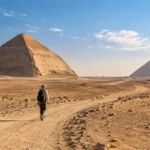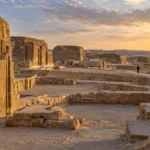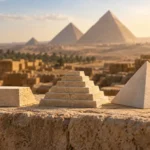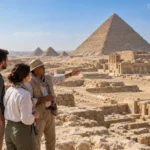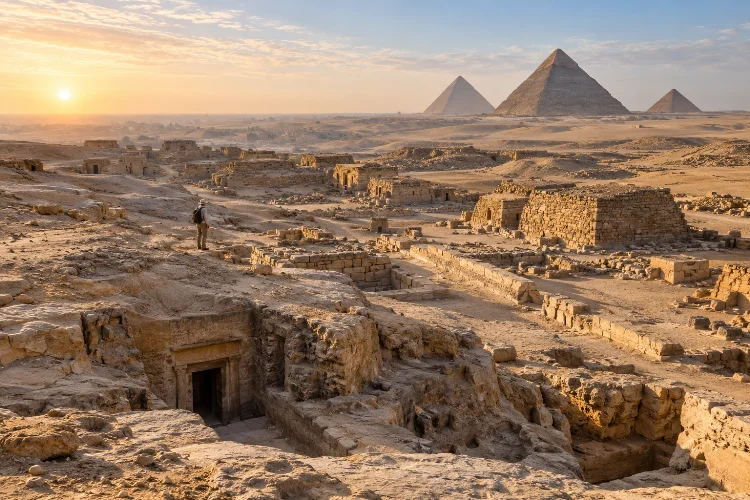
The first time most people picture Giza, the image is predictable: three enormous pyramids rising above the desert, the Great Sphinx in front, and perhaps a camel somewhere in the frame.
Those icons deserve their fame, but they represent only one layer of a much larger archaeological landscape. Exploring the Giza Pyramid Complex beyond the main tourist routes reveals something more interesting.
The plateau contains cemeteries of royal relatives and officials, temples, ancient causeways, workers’ settlements, subsidiary pyramids, rock-cut tombs, and traces of the communities that supported royal building projects thousands of years ago.
UNESCO places Giza within the wider Memphis necropolis, a vast archaeological zone extending through sites such as Saqqara and Dahshur.
Once you stop treating Giza as a checklist of three pyramids and a sphinx, the site begins to feel less like a collection of monuments and more like an ancient city of the dead.
See Giza as a Complete Archaeological Landscape
The Great Pyramid of Khufu naturally attracts most visitors. Built during Egypt’s Fourth Dynasty, it is the largest of the three principal pyramids and the only surviving Wonder of the Ancient World. Yet Khufu’s pyramid was never designed to stand alone.
Royal pyramid complexes included mortuary temples, valley temples, causeways, boat burials, queens’ pyramids, satellite pyramids, and surrounding tombs. The same broader pattern appears around the monuments of Khafre and Menkaure.
This changes the way you explore Giza. Rather than walking directly from one giant pyramid to another, pay attention to low walls, foundations, tomb entrances, changes in terrain, and alignments between structures.
Those smaller remains can seem unimpressive next to a 140-metre-scale pyramid, but they often explain how the entire ceremonial landscape functioned.
Wander Through the Eastern and Western Cemeteries
Some of Giza’s most overlooked areas are the Eastern and Western Cemeteries beside the Great Pyramid.
These burial grounds contain rows of mastabas, rectangular tomb structures built for important members of Egyptian society. The Eastern Cemetery was closely associated with Khufu’s relatives, while many high-ranking officials were buried in the Western Cemetery.
Walking between them gives you a very different perspective on ancient Egyptian hierarchy. Distance from the king’s pyramid was not random. Burial location, tomb scale, architecture, and decoration could all communicate status.
The Western Cemetery is especially interesting because of its almost grid-like layout. Among the people buried there was Hemiunu, an elite official associated with overseeing construction of the Great Pyramid.
It is easy to rush past these structures because they do not dominate the skyline. Spend time here, however, and the plateau starts looking less like three isolated monuments and more like a carefully planned royal necropolis.
Look for the Tombs That Tell Everyday Stories
Pyramids communicate power through enormous scale. Smaller tombs often communicate history through detail.
The Tomb of Queen Meresankh III is an excellent example. Located in the Eastern Cemetery, it preserves scenes showing activities such as bread making, beer brewing, herding, mat production, metalworking, and statue carving.
A striking group of female figures is also carved directly into one wall.
These images are valuable because they connect royal funerary beliefs with everyday economic life. Ancient Egypt suddenly feels less abstract when you see people producing food, making objects, and preparing goods for the afterlife.
Other tombs around the Eastern Cemetery belonged to powerful officials and royal family members. Some may open or close depending on conservation work, so don’t assume every chamber mentioned in an old travel blog will be accessible.
Access can change occassionally, making the Egyptian Ministry of Tourism and Antiquities website a better place to check before visiting.
Follow the Causeways Instead of Only Photographing Pyramids
One of the easiest ways to understand Giza is to follow the logic connecting pyramid, temple, and lower landscape.
Khafre’s complex is particularly useful because significant parts of its architectural relationship remain easy to recognize. His pyramid connects by causeway toward the valley temple area beside the Great Sphinx.
The Sphinx itself was carved from the natural limestone bedrock during the Fourth Dynasty and is generally associated with Khafre’s reign. The Sphinx Temple and Khafre’s Valley Temple help reveal that this famous statue was part of a much larger ceremonial enviroment.
Instead of photographing the Sphinx and immediately leaving, observe its position relative to the causeway and Khafre’s pyramid.
Suddenly, the architecture begins to make spatial sense. The monuments were designed as connected ritual landscapes rather than individual attractions competing for attention.
Discover the World of the Pyramid Workers
One of the most interesting ways to move beyond the standard Giza experience is to learn about the people who actually kept these projects running.
Southeast of the major pyramid complexes lies Heit al-Ghurab, associated with the settlement of workers involved in constructing the complexes of Khafre and Menkaure.
Archaeologists uncovered streets, houses, storage areas, administrative buildings, and evidence of large-scale food provisioning.
Animal remains discovered there include cattle, sheep, goats, pigs, birds, and fish. Evidence from nearby burials also indicates physically demanding labour, including healed injuries.
This matters because the pyramids are often discussed entirely in terms of kings and engineering. The workers’ settlement brings administrators, craftspeople, food producers, supervisors, and labourers back into the story.
Not every archaeological section is always open for unrestricted wandering, however. Visit only areas currently designated for public access rather than crossing barriers to reach excavations.
Explore Giza at a Slower Pace
A major advantage of leaving the busiest route is simply having more time to observe.
Around the main viewpoints, visitors frequently move quickly between predetermined photo stops. In quieter sections, details become easier to notice: tool marks on stone, remains of walls, tomb shafts, changes in limestone quality, and the alignment of monuments across the plateau.
The desert landscape itself also becomes part of the experience. From wider areas of the plateau, you can understand how the pyramids relate to one another rather than viewing each structure from directly below.
This is particularly useful for photography. A distant viewpoint often produces a stronger image than standing beside the pyramid, because seperated monuments can finally be seen as part of one composition.
Go early when possible. Cooler temperatures and softer morning light make longer exploration far more comfortable, especially if you plan to spend several hours walking.
Build a Route That Goes Beyond the Highlights
You do not need to skip the famous monuments to have a less conventional visit. The better strategy is to combine them with overlooked areas.
Begin near Khufu’s pyramid while energy levels are high. From there, explore accessible sections of the Western or Eastern Cemetery before continuing toward Khafre’s complex and the causeway.
If the Tomb of Meresankh III or other decorated tombs are open, adding one provides valuable contrast with the monumental architecture outside. Later, spend time around the Sphinx and valley temple area rather than treating them as a quick final photo stop.
Travellers interested in archaeology can also investigate whether designated workers’ cemetery areas or additional tombs are accessible during their visit. The official Giza Plateau information notes that some attractions require separate tickets from general area admission.
Most importantly, stay on authorised visitor paths. Archaeological restrictions exist partly because many surfaces and structures are extremly vulnerable to damage.
Why the Less Famous Parts of Giza Matter
UNESCO’s Memphis necropolis includes not only pyramids but thousands of rock-cut tombs, mastabas, temples, settlements, and other archaeological remains spanning long periods of Egyptian history.
That broader perspective explains why the smaller features at Giza deserve attention.
The Great Pyramid shows what centralized royal power could achieve. Elite cemeteries reveal political and family relationships. Tomb art preserves scenes of food production and craftsmanship. Workers’ settlements reveal the logistics behind monumental construction.
Together, these places create a much richer picture than the famous skyline alone.
Exploring the Giza Pyramid Complex beyond the main tourist routes transforms a familiar attraction into a much deeper archaeological experience.
The Great Pyramid, Khafre’s pyramid, Menkaure’s pyramid, and the Sphinx remain essential, but they are only the beginning.
Spend time among mastaba cemeteries, study decorated tombs, trace ancient causeways, notice temple foundations, and learn about the workers who supported these enormous royal projects. The quieter parts of the plateau often provide the context needed to understand the famous ones.
Before visiting, check current opening conditions and ticket requirements through official Egyptian sources, since individual tombs and archaeological zones can close for conservation.
Then give yourself enough time to wander slowly. Giza rewards curiosity far more than a rushed photo stop.