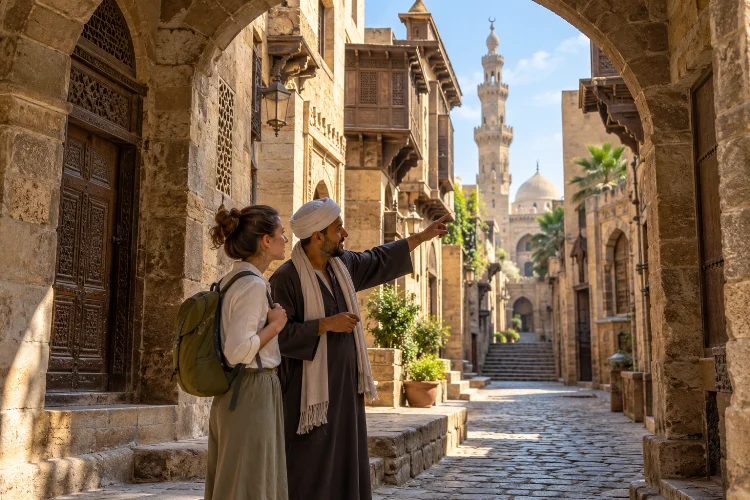
Medieval Cairo is the kind of place that rewards walking.
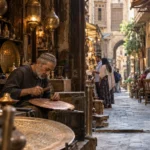
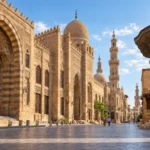
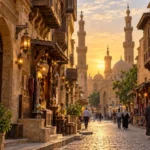
The most memorable moments are often not inside a famous mosque or museum, but somewhere between them: a stone arch appearing at the end of a narrow lane, a carved wooden balcony above a spice shop, or the sudden sight of a minaret rising behind a crowded market.
Planning a cultural walking route through Medieval Cairo is therefore less about covering as many monuments as possible and more about following the historical structure of the city.
Historic Cairo preserves layers from the Fatimid, Ayyubid, Mamluk, and later periods, with religious buildings, commercial streets, fountains, schools, houses, and defensive gates still woven into active neighborhoods.
UNESCO describes the district as an exceptional survival of medieval urban fabric rather than simply a collection of individual monuments.
A good route should combine architecture, local street life, rest stops, and enough flexibility to explore whatever catches your attention.
Start at Bab al-Futuh in the Morning
Begin your walk at Bab al-Futuh, the Gate of Conquests, at the northern end of Al-Muizz Street.
The gate was built in 1087 during the Fatimid period under the powerful vizier Badr al-Jamali. Along with Bab al-Nasr and Bab Zuwayla, it represents one of the most impressive surviving examples of medieval military architecture in Cairo.
Starting here gives the route a natural historical logic. You enter the old Fatimid city from one of its original defensive gateways and then gradually walk south through later architectural periods.
Spend a few minutes examining the rounded towers, stone details, and defensive structure before moving on. The gate itself is currently listed as free to visit, although access conditions can always change.
Morning is ideal because the streets are generally more comfortable before the heat and crowds build.
Follow Al-Muizz Street as Your Main Route
From Bab al-Futuh, continue south along Al-Muizz Street, which should form the backbone of your walking itinerary.
The historic road stretches between Bab al-Futuh and Bab Zuwayla and contains 29 registered monuments representing periods from the 10th through the 19th centuries.
The Egyptian Ministry of Tourism and Antiquities describes it as one of the richest concentrations of Islamic monuments in the city
You could rush from one major monument to another, but that would miss much of the point.
Pay attention to the street itself. Markets, workshops, religious buildings, residences, side alleys, and traditional commercial activities create the atmoshpere that makes the area feel alive rather than museum-like.
This section is also where you begin to see different architectural styles overlapping. Fatimid simplicity can sit surprisingly close to highly decorated Mamluk stonework, while later Ottoman buildings introduce their own visual language.
Pause at Al-Hakim and Al-Aqmar
Soon after entering the historic district, consider stopping at the Mosque of al-Hakim before continuing toward Al-Aqmar Mosque.
These two buildings help explain early Fatimid Cairo in very different ways. Al-Hakim is monumental, with a large courtyard and strong architectural presence, while Al-Aqmar is much smaller and integrated directly into the street.
Al-Aqmar is especially useful for understanding medieval urban design. Its façade was arranged to follow the street line while the prayer space behind it remained correctly oriented toward Mecca.
That small design decision tells you a lot about how architects worked inside a dense city. They were not constructing isolated monuments on empty land; they had to adapt religious architechture to existing streets, property lines, and movement.
Spend time looking at stone carving, inscriptions, doorways, and façade details rather than focusing only on interiors.
Slow Down Around Bayn al-Qasrayn
The central stretch of Al-Muizz contains some of the most impressive Mamluk architecture in Cairo.
One of the major landmarks is the complex of Sultan al-Mansur Qalawun, built in 1283–1284. It included a madrasa, mausoleum, and bimaristan, or hospital, showing how monumental architecture could combine education, religion, medicine, and royal commemoration.
This area is worth slowing down for because several important buildings appear very close together.
Instead of treating each structure seperately, compare them. Look at differences in entrance portals, stone colors, minarets, windows, domes, and decorative carving.
The current Al-Muizz ticket information lists an inclusive admission option covering several monuments in this central zone, including the Qalawun Group, Sultan Barquq Mosque, Amir Beshtak Palace, and other sites.
Prices can change, so check the official monument site shortly before visiting.
Allow at least an hour in this section if you enjoy architecture.
Make Khan al-Khalili Your Midday Break
Around the middle of the walk, take a detour toward Khan al-Khalili.
The market area works well as a practical break because it offers cafés, food, drinks, shopping, and a change of pace from monument-heavy sightseeing.
You do not need to spend hours souvenir hunting. Instead, use the district to understand the relationship between commerce and medieval Cairo.
Historic Cairo grew partly because of its position within major trade routes, and commercial life was deeply connected to its religious and political institutions.
UNESCO notes that streets were historically associated with particular crafts and markets, many of which helped shape the identity of individual districts.
A short coffee or lunch break here can keep the rest of the walk enjoyable.
If you want another major religious stop, Al-Azhar is nearby. UNESCO identifies it as an important theological and academic institution dating back to the foundation of Fatimid Cairo.
Continue Through the Al-Ghuri District
After lunch, return toward Al-Muizz and continue south toward the Sultan al-Ghuri Complex.
Built in 1503–1504, the complex represents one of the final great architectural statements of the Mamluk period before the Ottoman conquest of Egypt. It included a mosque, madrasa, mausoleum, khanqah, sabil, kuttab, and residential spaces.
Its design is particularly interesting because buildings face one another across the street.
This creates a dramatic urban space rather than a single isolated monument. A covered section historically connected the buildings and sheltered commercial activity below.
Nearby commercial architecture is also worth noticing. Al-Ghuri’s wikala once provided storage and lodging for merchants, illustrating how Cairo’s trade networks shaped the built environment.
By this point in the walk, the changes between early Fatimid and late Mamluk design should become much easier to recognise.
Finish the Core Route at Bab Zuwayla
Continue south until you reach Bab Zuwayla, one of the most atmospheric endings for the core walking route.
The gate was built in 1092 and originally formed the southern entrance to Fatimid Cairo. Its massive towers later became the foundations for the minarets of the adjacent Mosque of Sultan al-Mu’ayyad.
Bab Zuwayla also witnessed major political events.
In 1517, the final Mamluk sultan of Egypt, Tumanbay, was executed here after the Ottoman conquest, making the gate both an architectural landmark and a place associated with the end of an era.
If upper access is available, the views can help you understand the city from above. Domes, roofs, minarets, and crowded streets suddenly connect into one larger urban landscape.
For many visitors, this is a satisfying place to finish the main route.
Add Darb al-Ahmar if You Still Have Energy
If you still feel fresh in the late afternoon, extend your walk into nearby Darb al-Ahmar rather than immediately leaving the historic district.
This area feels more residential than the main monument corridor and can offer a stronger sense of everyday neighborhood life.
Do not approach it as another checklist. Walk slowly through public streets, observe restored buildings, local workshops, mosques, and the changing relationship between monuments and ordinary homes.
This is where a cultural walking route becomes more than sightseeing.
The surviving street network matters just as much as famous buildings. UNESCO specifically highlights Historic Cairo’s traditional neigborhood structure, historic markets, sabils, madrasas, palaces, and other buildings that remain integrated into the city.
Plan Your Timing Around Experience, Not Distance
The physical distance of the core route is manageable, but the number of places worth stopping at can turn it into a full-day experience.
A sensible plan is to begin around 9:00 AM, spend the morning moving from Bab al-Futuh through central Al-Muizz, stop around Khan al-Khalili near midday, and continue toward Al-Ghuri and Bab Zuwayla in the afternoon.
Do not schedule a monument every 15 minutes.
A decorated doorway may hold your attention longer than expected. You may discover a courtyard, traditional shop, or side street worth exploring.
Comfortable shoes are essential, and modest clothing is useful if you plan to enter active mosques. Carry water, but expect plenty of places to stop for tea, coffee, or food.
Also remember that operating hours and ticket systems can change. The official Al-Muizz page currently publishes admission information for several monuments, so checking it shortly before your visit is smarter than relying on an old itinerary.
Planning a cultural walking route through Medieval Cairo works best when you treat the city itself as the attraction.
Start at Bab al-Futuh, follow Al-Muizz through Fatimid and Mamluk monuments, slow down around the Qalawun complex, take a break near Khan al-Khalili, then continue through the Al-Ghuri district toward Bab Zuwayla.
The route connects military gates, mosques, schools, markets, hospitals, houses, and commercial buildings within a single historic urban landscape.
Give yourself a full day rather than racing through it. Check current monument access before leaving, wear comfortable shoes, and build enough flexibility into the itinerary to follow interesting side streets.
Medieval Cairo is at its best when you stop trying to complete a checklist and simply start noticing the city around you.