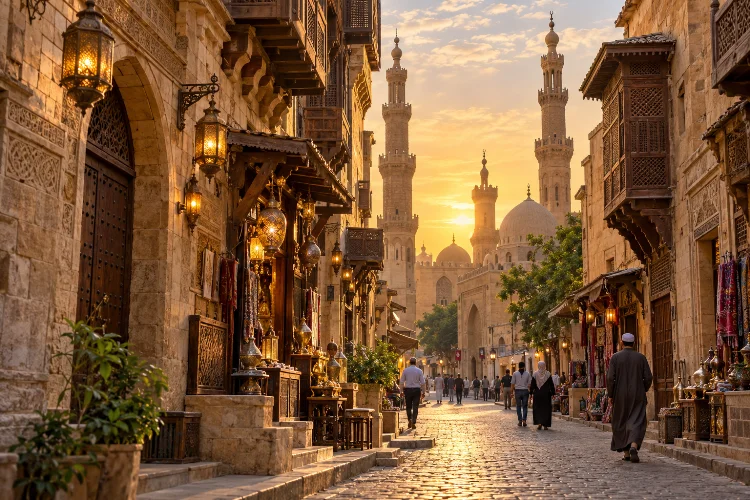
Cairo changes completely when you leave the wide modern avenues and enter its historic quarters.
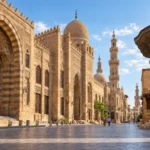
Traffic noise gives way to narrow lanes, stone façades, wooden balconies, market stalls, towering minarets, and buildings that have watched the city change for hundreds of years.
Exploring Islamic Cairo through its historic streets and mosques is less about checking individual monuments off a list and more about understanding how an entire medieval city developed.
Fatimid gates stand near Mamluk madrasas, Ottoman houses hide behind busy commercial streets, and mosques continue to function inside neighborhoods that have never become frozen museum districts.
UNESCO officially lists the area as Historic Cairo, a World Heritage Site since 1979. Its surviving urban fabric reflects more than a millennium of development, including Fatimid, Ayyubid, Mamluk, and Ottoman periods.
The best way to experience it is slowly and mostly on foot.
Begin at Bab al-Futuh and Enter Medieval Cairo
A memorable route starts at Bab al-Futuh, or the Gate of Conquests, at the northern end of historic Al-Muizz Street.
The gate was constructed in 1087 under the Fatimid vizier Badr al-Jamali. Together with Bab al-Nasr and the southern Bab Zuwayla, it formed part of the fortified walls protecting Fatimid Cairo.
Its rounded towers, arrow slits, heavy masonry, and defensive passages offer an immediate reminder that medieval Cairo was once a walled royal capital.
Walk through the gate rather than simply photographing it from outside. The transition works almost like entering a different city.
Just nearby stands the Mosque of al-Hakim bi-Amr Allah. Completed in 1013, it is one of Egypt’s oldest surviving mosques and has an enormous open courtyard surrounded by arcades.
Starting here also gives your walk a chronological logic: you are entering the Fatimid core before gradually encountering later architectural layers.
Walk the Length of Al-Muizz Street
Al-Muizz Street is the backbone of any serious exploration of Islamic Cairo.
Running between Bab al-Futuh and Bab Zuwayla, the historic route contains 29 registered monuments representing architectural periods from the 10th through the 19th centuries.
Egypt’s Ministry of Tourism and Antiquities describes it as one of the world’s richest concentrations of Islamic monuments.
The street is not simply a line of old buildings. Its appeal comes from the atmoshpere between them.
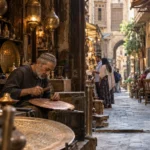
Small shops operate below centuries-old façades. Residents move through side alleys, vendors sell everyday goods, and restored monuments appear between buildings that still serve ordinary urban functions.
Look closely at details rather than constantly moving toward the next landmark. Carved stone entrances, mashrabiya screens, geometric patterns, inscriptions, muqarnas decoration, and minarets reveal how Islamic architecutre changed across different dynasties.
A slower pace also makes it easier to understand why UNESCO values Historic Cairo as an urban landscape rather than merely a collection of individual monuments.
Notice the Clever Design of Al-Aqmar Mosque
One of the smaller buildings on Al-Muizz Street demonstrates a surprisingly sophisticated architectural solution.
The Al-Aqmar Mosque, completed in 1125 during the Fatimid period, has one of Egypt’s oldest surviving decorated stone mosque façades. Its exterior follows the alignment of the street, while the interior remains correctly oriented toward the qibla, the direction of prayer.
That sounds simple until you look at the irregular medieval street around it.
The architects essentially created a building whose public façade responds to the urban environment while its religious interior follows a different orientation. It is a clever example of architecture adapting to the realities of a dense city.
The façade itself deserves several minutes of attention. Look for carved medallions, Kufic inscriptions, geometric patterns, and carefully arranged stone decoration.
Al-Aqmar proves that a monument does not need to be enormous to be architecturally important.
Spend Time at the Qalawun Complex
Farther along Al-Muizz Street, the Qalawun Complex shows just how ambitious Mamluk architecture could become.
Sultan al-Mansur Qalawun established the complex in 1283-1284. Rather than building only a mosque, he created a multifunctional institution incorporating a madrasa, mausoleum, and bimaristan, or hospital.
That combination tells us something important about medieval Cairo.
Major religious complexes could simultaneously support worship, education, medicine, charitable activity, royal commemoration, and urban prestige. Architecture was deeply connected with public institutions.
The mausoleum is particularly striking, with elaborate stonework, decorative surfaces, and a dramatic interior. Nearby Mamluk buildings belonging to later rulers turned this stretch of the street into an extraordinary sequence of monumental façades.
Instead of viewing them seperately, compare their portals, minarets, windows, domes, and stone decoration. You can almost watch Mamluk design evolve while walking a few hundred metres.
Detour Through Khan al-Khalili and Al-Azhar
Historic Cairo is not complete without experiencing its commercial side.
Khan al-Khalili developed into one of Cairo’s best-known market districts, and although parts are now heavily oriented toward visitors, the surrounding lanes still communicate the historic connection between commerce and the religious city.
Nearby stands Al-Azhar, established soon after the Fatimid conquest of Egypt. Cairo was founded in 969, and the original Al-Azhar Mosque was commissioned in 970 as the new city’s first congregational mosque.
It later became one of the Islamic world’s most influential centres of religious scholarship. The area is especially interesting because it remains active rather than purely archaeological.
Students, worshippers, shopkeepers, residents, and visitors constantly move through the surrounding streets. That living quality is essential to Islamic Cairo’s character.
When entering an active mosque, dress modestly, remove shoes when required, and avoid wandering through prayer areas during congregational worship. Photography rules can vary, so follow instructions at each site.
End Al-Muizz Street at Bab Zuwayla
Continue south until the medieval street reaches Bab Zuwayla.
Built in 1092, the gate marked the southern entrance to Fatimid Cairo. Its two semicircular towers later became bases for the minarets of the Mosque of Sultan al-Mu’ayyad Shaykh, constructed in the early 15th century.
The site also witnessed darker episodes of Cairo’s history.
In 1517, the last Mamluk sultan, Tumanbay, was executed at Bab Zuwayla following the Ottoman conquest of Egypt. The event symbolically marked the end of Mamluk political rule.
If upper access is available during your visit, climbing the monument can provide excellent views over the surrounding roofs, domes, and minarets.
From above, Cairo’s historic skyline makes more sense. Monuments that seem isolated at street level suddenly become part of a dense architectural network.
Visit Ibn Tulun for a Completely Different Mosque Experience
Al-Muizz receives much of the attention, but one of Cairo’s most important mosques lies farther south.
The Mosque of Ahmad Ibn Tulun was constructed between 876 and 879 as the congregational mosque of al-Qata’i, the administrative capital created by Ahmad Ibn Tulun.
Its architecture feels dramatically different from the narrow streets of Fatimid and Mamluk Cairo.
The mosque opens around a huge courtyard surrounded by arcades. Its stucco decoration uses geometric and floral patterns, while the famous spiral-form minaret recalls architectural traditions associated with Abbasid Samarra in Iraq.
Spend time simply walking around the courtyard.
The scale, repetition of arches, open sky, and relative simplicity create a calmer experience than many later Mamluk monuments. It is also one of the best places to understand that Cairo’s Islamic history began well before the Fatimid foundation of al-Qahira.
UNESCO specifically identifies Ibn Tulun as an outstanding surviving example of early Islamic architecture.
Finish With the Monumental Mosque of Sultan Hassan
For a dramatic finale, continue toward Salah al-Din Square below the Citadel.
Here stands the enormous Mosque and Madrasa of Sultan Hassan, constructed between 1356 and 1362. It represents Mamluk architecture at its most ambitious scale.
Inside, a central courtyard is surrounded by four monumental iwans. Separate madrasas were created for the four Sunni schools of Islamic jurisprudence, with student accommodation and service areas integrated into the complex.
The building also had a strategic dimension.
Because it stands close to the Citadel, the structure was sometimes used during political conflicts as a position from which forces could threaten the fortress. Its massive walls therefore feel appropriate to both its religious and turbulent political history.
Standing in the courtyard after walking Cairo’s crowded streets creates a striking contrast: suddenly the city feels monumental and quiet.
Explore the Streets, Not Just the Famous Buildings
The biggest mistake when visiting Islamic Cairo is spending the entire day rushing between named attractions.
Historic Cairo’s real character survives in its smaller neigborhoods and connecting streets. UNESCO highlights not only monumental mosques but also historic houses, sabils, madrasas, hammams, markets, workshops, and traditional street patterns.
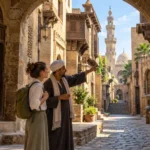
Allow yourself to wander into side lanes where access is clearly public.
You may find Ottoman houses with wooden screens, tiny mosques squeezed between shops, craftsmen working behind open doors, old fountains built to provide drinking water, and unexpected views of minarets framed between buildings.
Morning is good for architectural exploration, while late afternoon and early evening bring a different character as streets become busier and historic façades begin to glow under artificial lighting.
Either way, comfortable shoes matter. Historic Cairo is best understood one street at a time.
Exploring Islamic Cairo through historic streets and mosques reveals far more than a collection of beautiful religious buildings.
The Fatimid gates show how the medieval city was defended, Al-Muizz Street preserves centuries of changing architectural styles, the Qalawun complex demonstrates the social role of Mamluk institutions, and Ibn Tulun reaches back to an even earlier chapter of Cairo’s Islamic history.
Add Al-Azhar, Bab Zuwayla, Khan al-Khalili, and the monumental Mosque of Sultan Hassan, and the city begins to read like an architectural timeline.
Give the district at least a full day, walk whenever practical, and leave gaps in your itinerary for unexpected streets and buildings.
Before visiting, check current monument opening hours and entry rules, then explore slowly – the spaces between Cairo’s famous landmarks often tell just as much history as the landmarks themselves.