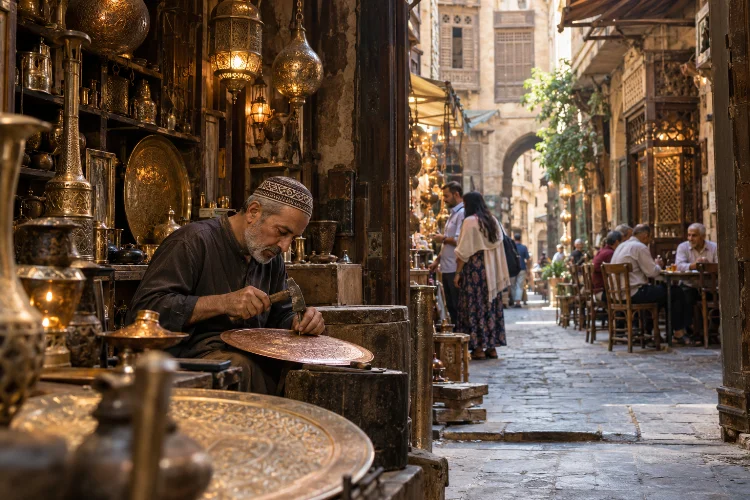
Khan el-Khalili is usually introduced as Cairo’s famous place to buy lanterns, perfume, jewelry, spices, scarves, and pyramids small enough to fit in your suitcase. That description is not wrong, but it misses most of what makes the district interesting.
The bazaar grew from Cairo’s medieval commercial world and remains closely connected to Historic Cairo’s mosques, caravanserais, workshops, cafés, and maze-like streets.
Cairo’s official tourism portal describes Khan al-Khalili as a market with more than six centuries of history, while Egypt’s tourism authority still presents it as a labyrinth of shops and historic alleyways.
Learning how to experience Khan el-Khalili beyond the tourist markets means slowing down.
Instead of treating the neighborhood as one giant souvenir store, look for traces of its trading history, follow craftsmen into quieter lanes, study Mamluk architecture, sit somewhere long enough to watch everyday life, and connect the bazaar with the wider streets of Islamic Cairo.
Understand Khan el-Khalili as a Historic Trading District
The first step is changing how you think about the bazaar.
Khan el-Khalili emerged during the Mamluk period. The original khan – a commercial building for merchants and goods – was established in the late 14th century by Jaharkas al-Khalili during the reign of Sultan Barquq.
Over time, its name expanded from one trading building to the surrounding commercial district. Cairo’s official portal describes the market as more than 600 years old.
A traditional khan or wikala was more sophisticated than a row of shops. Merchants could store goods on lower levels while lodging or working in rooms above or around an internal courtyard.
That history explains the dense layout you see today. The narrow lanes were shaped by trade, storage, workshops, religious institutions, and movement through a crowded medieval city.
Once you understand that, even an old stone arch or upper-floor wooden window becomes more interesting than another rack of souvenirs.
Leave the Main Souvenir Lanes
The busiest entrances make Khan el-Khalili feel extremely tourist-oriented.
You will see brass lamps, decorative boxes, imitation antiquities, textiles, papyrus-style artwork, jewelry, incense, leather goods, and countless Egyptian-themed souvenirs.
Egypt’s official tourism portal highlights many of these products, including copper, brass, stained-glass lanterns, spices, jewelry, and handmade leather pieces.
Browse them if something catches your attention, but don’t stop there.
Turn into smaller public alleys and notice how quickly the atmoshpere can change. Some passages feel commercial but less staged, while others lead toward workshops, local shops, residential entrances, historic buildings, and quieter corners.
The goal is not to search obsessively for an allegedly “secret” market without tourists. Khan el-Khalili has been a famous commercial district for centuries.
Instead, move beyond the handful of streets where nearly every shop sells the same visitor-oriented products.
Look for Crafts Rather Than Just Finished Souvenirs
Shopping becomes much more interesting when you pay attention to how objects are produced.
Historic Cairo remains associated with artisans and craftsmen, and Egypt’s tourism authority specifically notes working craftspeople throughout the area’s old streets.
Listen for the sound of metal being worked. Look into open workshops where appropriate, notice stacks of unfinished products, and distinguish mass-produced objects from pieces that show signs of manual work.
Metal lanterns are a good example. Instead of immediately asking the price of a finished lamp, examine the pierced metal patterns, glass panels, soldering, and differences between several examples.
The same approach works with wood, textiles, leather, jewelry, and decorative metalware.
There is no need to interrogate every shopkeeper about production methods. A relaxed conversation often reveals more, particulary if the shop is not crowded.
Buying one carefully chosen object with a clear connection to local craftsmanship can also feel more meaningful than filling a bag with generic souvenirs.
Connect the Bazaar With Al-Muizz Street
One of the easiest ways to deepen your visit is to stop treating Khan el-Khalili as an isolated destination.
Nearby Al-Muizz Street runs through the historic center and passes Khan al-Khalili as part of a broader network of medieval streets.
Egypt’s Ministry of Tourism and Antiquities says 29 monuments along Al-Muizz represent periods extending from the 10th to the 19th centuries.
This makes it easy to combine market exploration with architecture.
Walk west toward Al-Muizz and suddenly the shopping experience becomes part of a much larger historical landscape.
Mosques, madrasas, mausoleums, houses, sabils, and commercial structures reveal how religion, education, charity, and trade once operated side by side.
UNESCO emphasizes that Historic Cairo remains remarkable for the survival of its medieval urban structure and its long role as a political, cultural, religious, and commercial center connecting major international trade routes.
You do not need to visit every monument. Even a short detour helps explain why Khan el-Khalili developed where it did.
Explore the Al-Ghuri Area and Its Trading Architecture
South of the bazaar, the area associated with Sultan al-Ghuri is especially useful for understanding medieval commerce.
The Sultan al-Ghuri Complex, built in 1503–1504, incorporated religious, educational, charitable, residential, and commercial functions. Its buildings included a mosque, madrasa, mausoleum, Sufi khanqah, public fountain, school, and accommodation.
Nearby Wikala al-Ghuri makes the commercial story even clearer.
Its open courtyard was surrounded by multiple levels. Lower spaces were associated with the storage of merchants’ goods, while upper rooms served as accommodation. The surviving building also preserves examples of late Mamluk stone and wood craftsmanship.
Egypt’s official tourism site notes that the wikala now functions as a cultural center where workshops and performances may take place.
Visiting a structure like this helps you picture Khan el-Khalili before modern storefronts and electric lighting. Commerce required warehouses, lodging, courtyards, security, transport, and networks linking merchants across regions.
The bazaar suddenly becomes economic history rather than simply shopping.
Stop for Tea Instead of Constantly Moving
One of the easiest ways to miss Khan el-Khalili is to walk through it too quickly.
Find a café or simple place to sit and give yourself at least 20 or 30 minutes without trying to accomplish anything.
Watch shopkeepers interact with regular customers. Notice delivery workers moving goods through streets too narrow for conventional vehicles. Listen to conversations, calls to prayer, metalwork, bargaining, and the constant movement between shops.
This kind of pause reveals the district’s rhythm.
It also helps separate the experience from the pressure to buy something every few minutes. You are allowed to simply observe.
Historic Cairo developed as a place where commercial, social, religious, and residential life overlapped. UNESCO still identifies the survival of that complex urban pattern as one of the area’s defining characteristics.
A café chair can therefore become a surprisingly useful historical viewpoint.
Visit at Two Different Times of Day
Khan el-Khalili changes considerably depending on when you arrive.
Morning is better for slow architectural exploration. Streets can feel easier to navigate, and daylight makes it simpler to notice stone arches, carved façades, wooden screens, and older architechture.
Late afternoon and evening offer something different.
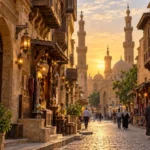
Shop lights come on, metal lanterns glow, cafés become busier, and the neighborhood feels more theatrical. The maze of narrow streets creates layers of warm light, shadow, merchandise, and people.
If your schedule allows, arrive in the afternoon and stay into early evening. That gives you both experiences without making two separate trips.
Photographers should still remember that this is not a movie set. Ask before making one shopkeeper or craftsperson the obvious subject of a close photograph, especially when entering smaller working spaces.
Bargain Without Turning Every Purchase Into a Battle
Negotiating prices is part of the experience in many sections of the bazaar, but it does not need to become aggressive.
If something interests you, ask the price, decide what you would realistically pay, and negotiate calmly. If you are nowhere near agreement, smiling and walking away is usually easier than arguing.
Avoid beginning long negotiations over an item you have absolutely no intention of buying.
It wastes everyone’s time and can turn a relaxed interaction into an uncomfortable one.
Also compare similar objects before purchasing. The main visitor corridors may contain many nearly identical pieces, while smaller shops may offer different quality, materials, or workmanship.
If craftsmanship matters more than obtaining the lowest possible price, ask about materials and production rather than concentrating exclusively on discounts.
The experience is much more enjoyable when shopping remains a conversation instead of a competition.
Give Yourself Time to Get Slightly Lost
Navigation apps are useful, but they can make you too efficient.
Khan el-Khalili and the surrounding Historic Cairo district make more sense when you occasionally stop following the shortest route.
Explore public lanes that look interesting. Walk toward a visible minaret or unusual stone portal. Follow a craft street for a few minutes and then return.
Al-Muizz itself connects historic alleys including Khan al-Khalili and al-Ghuriyya, demonstrating how deeply the bazaar is integrated into a much larger urban network.
Of course, use normal city awareness and avoid entering private residential areas simply because a doorway looks historic.
But allow enough flexibility for unexpected discoveries.
A four-hour visit with no rigid shopping list will usually reveal more than a one-hour dash through the famous souvenir corridors.
Knowing how to experience Khan el-Khalili beyond the tourist markets changes the bazaar from a shopping stop into a window onto Cairo’s commercial and cultural history.
Explore the smaller lanes, notice working crafts, connect the market with Al-Muizz Street, and visit historic trading buildings such as Wikala al-Ghuri.
Most importantly, slow down. Have tea, watch the movement of the streets, compare architectural details, and give yourself permission to wander without buying anything.
Khan el-Khalili has survived because it is more than a souvenir destination. It belongs to a much larger urban landscape shaped by trade, religion, craftsmanship, and everyday life.
Set aside several hours, explore beyond the obvious entrances, and you will discover a far richer side of medieval Cairo.