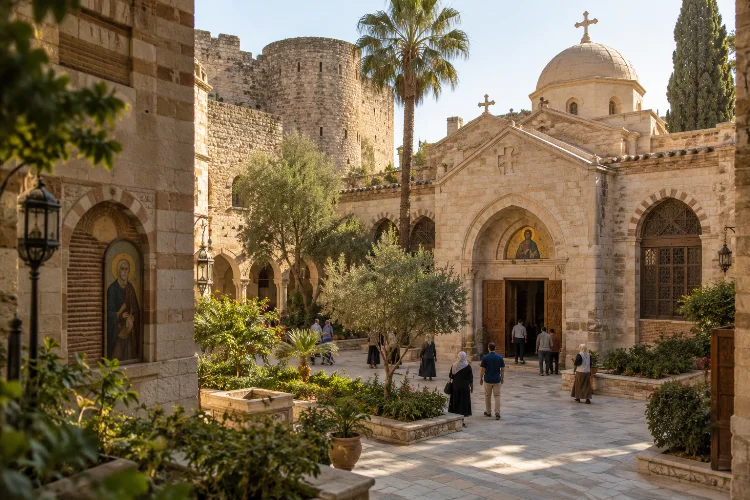
Cairo may be famous for pyramids and medieval mosques, but another layer of the city’s history is hidden behind the walls of Old Cairo.
Narrow pedestrian lanes lead to ancient churches, Roman fortifications, religious artwork, quiet courtyards, and places connected with traditions stretching back to Christianity’s earliest centuries in Egypt.
Exploring Coptic Cairo’s churches and early Christian heritage offers a completely different experience from the busier archaeological sites around the Egyptian capital.
Instead of enormous monuments surrounded by open desert, you encounter a compact religious district where historical buildings remain closely connected to active worship.
Coptic Christianity traces its Egyptian tradition back to Saint Mark and the first century AD, while the Coptic Museum preserves material showing how Egyptian Christian art developed through interactions with Pharaonic, Greek, Roman, Byzantine, and later cultures.
The best way to experience this history is slowly. Churches, museums, Roman ruins, icons, and local traditions all sit within walking distance of one another.
Begin With the Roman Fortress of Babylon
One of the most useful things to understand about Coptic Cairo is that its Christian monuments developed within a much older landscape.
The district grew around the remains of the Roman Fortress of Babylon, whose surviving towers and walls became incorporated into later religious buildings. This mixing of Roman military infrastructure and Christian architecture gives Old Cairo much of its unusual character.
The fortress also helps explain why some churches appear hidden below modern street level or squeezed between older masonry. Cairo has accumulated architectural layers for centuries rather than developing on one flat surface.
This is especially obvious around the Hanging Church and Coptic Museum, both located within the historic fortress area. The museum itself stands inside the boundaries of Roman Babylon and is surrounded by several of Old Cairo’s most important religious monuments.
Instead of walking directly toward the churches, spend a few minutes noticing the old walls and towers first. They provide the physical foundation for much of what comes next.
Step Inside the Famous Hanging Church
The Hanging Church, also known as Saint Virgin Mary’s Coptic Orthodox Church, is usually the most recognizable landmark in Coptic Cairo.
Its name comes from its position above the remains of the Roman fortress. Parts of the church were constructed over the old fortifications, giving the impression that the building was suspended above them.
Egyptian heritage sources also associate the church with the historic Coptic papal seat during the medieval period.
Inside, the atmosphere changes quickly from the busy city outside.
Marble columns divide the interior, while a wooden vaulted ceiling covers the main space.
The church contains an eleventh-century marble pulpit supported by decorated columns, along with a collection of religious icons. Some surviving icons date to the fifteenth century, although many are from later periods.
Look closely at the woodwork and screens around the sanctuary. Coptic architechture often rewards visitors who slow down and examine small details rather than simply photographing the entire room.
The building remains an active religious site, so respectful clothing and quiet behavior are important.
Explore Abu Serga and the Holy Family Tradition
A short walk away stands the Church of Saint Sergius and Bacchus, commonly called Abu Serga.
The exact age of the existing structure remains debated, but the church holds exceptional importance in Coptic tradition because of its association with the journey of the Holy Family through Egypt.
It was named after Sergius and Bacchus, Christian saints traditionally believed to have been martyred in Syria during the early fourth century.
The most famous feature lies beneath the main church.
An underground cave or crypt is traditionally associated with the Holy Family’s stay in the area during their flight into Egypt. Egypt’s Ministry of Tourism and Antiquities includes Old Cairo among the locations connected with this wider sacred journey.
Architecturally, Abu Serga follows a basilica-style arrangement with a narthex, nave, and sanctuary.
Elements such as wooden screens, columns, a baptismal font, and religious decoration show how Egyptian Christian communities developed distinctive church spaces over time.
Whether you approach the Holy Family story as faith, history, or cultural tradition, the church reveals how strongly sacred memory can become attached to a physical place.
Look for the Language of Early Coptic Architecture
Individual churches are fascinating, but Coptic Cairo becomes more interesting when you start comparing them.
Early Christian architecture in Egypt frequently adapted forms already familiar in the Roman world, particularly the basilica plan.
Long central naves, side aisles, columns, sanctuaries, and wooden screens were gradually combined with distinctly Egyptian Christian traditions.
Reused architectural materials are also common.
Marble columns, pieces of older masonry, carved wooden panels, and stone elements from different periods appear throughout the district. Rather than seeing this as inconsistency, think of it as a record of continous rebuilding.
Churches were damaged, reconstructed, expanded, and restored over many centuries. What visitors see today is therefore rarely a perfectly preserved building from one historical moment.
This layered quality is part of the attraction. A church may preserve an ancient plan, medieval woodwork, later icons, and modern religious activity all within the same space.
Spend Time Inside the Coptic Museum
If you want to understand what you have seen inside the churches, the Coptic Museum is essential.
Founded through the efforts of Marcus Simaika Pasha and inaugurated in 1910, the museum contains the world’s largest collection devoted to Coptic material heritage.
Its collections trace Egyptian Christianity from its early development and show how Coptic artists interacted with Pharaonic, Greek, Roman, Byzantine, and Ottoman artistic traditions.
The collection includes manuscripts, textiles, carved wood, stone sculpture, icons, metalwork, frescoes, and architectural fragments recovered from churches and monasteries.
This variety is particulary useful because it demonstrates that Coptic art was never culturally isolated.
Some objects retain visual ideas recognizable from ancient Egyptian traditions. Others show strong Mediterranean or Byzantine influences, while still developing forms that became distinctly Coptic.
The museum contains 26 halls plus a section devoted to material from Old Cairo churches. Its older wing also incorporates decorative architectural elements such as wooden ceilings, mashrabiya work, marble columns, and mosaics.
Give it at least an hour rather than treating it as a quick stop between churches.
Remember That Coptic Cairo Is Living Heritage
One of the most important differences between Coptic Cairo and a conventional archaeological site is that many of its monuments remain religious spaces.
People come here for worship, community events, pilgrimage, and prayer – not only sightseeing.
That living dimension changes how the district should be explored. A church interior may suddenly become quiet for prayer, certain sections may be temporarily unavailable, or visitors may be asked to avoid photography during services.
It also means the history here did not simply end in late antiquity.
Coptic communities continued maintaining churches, producing religious art, educating clergy, and reshaping the district through medieval and modern periods.
UNESCO’s documentation of Historic Cairo also recognizes the long presence of the Coptic Orthodox Patriarchate within the city’s historic religious landscape.
Seeing worshippers alongside ancient architectural elements makes that continuty much easier to understand.
Add Nearby Churches and Religious Landmarks
Once you have visited the Hanging Church and Abu Serga, leave time for the smaller lanes of the religious complex.
Other churches and Christian institutions are located within this compact area, while nearby Jewish and Islamic monuments show how several religious communities occupied interconnected parts of Old Cairo.
This makes the neighborhood valuable beyond Christian history alone.
Within a relatively short walking distance, visitors can encounter the Hanging Church, Abu Serga, the Coptic Museum, historic synagogue heritage, and monuments connected with early Islamic Cairo.
Egypt’s Ministry of Tourism and Antiquities describes the museum as being surrounded by some of the area’s oldest churches and other religious landmarks.
Avoid turning the visit into a race between buildings. The narrow lanes, stone walls, courtyards, stairways, and unexpected views between monuments are part of the experience.
Sometimes the most memorable moment is simply finding a quiet church entrance below the level of the surrounding modern city.
Plan a Comfortable Half-Day Visit
Coptic Cairo is compact enough to explore without complicated transportation between every attraction.
The Coptic Museum identifies Mar Gerges in Old Cairo as its location and notes that the area is accessible by metro. This makes it relatively convenient to combine several nearby heritage sites on foot once you arrive.
A practical order is to begin around the Roman fortress remains, visit the Hanging Church, continue toward Abu Serga, and then spend the later part of the visit inside the Coptic Museum.
Allow roughly three to five hours if you enjoy history and religious architecture.
Go earlier in the day when possible and check current opening information before leaving. The churches remain active places of worship, while museum opening hours, tickets, restoration work, or access arrangements can change.
Dress modestly, keep your voice low inside religious spaces, and avoid interrupting services for photographs. These simple habits make the enviroment more comfortable for both visitors and worshippers.
Exploring Coptic Cairo’s churches and early Christian heritage reveals a side of Egypt that can easily be overshadowed by pyramids, pharaohs, and medieval Islamic architecture.
The Roman Fortress of Babylon provides the ancient foundation, the Hanging Church demonstrates centuries of Coptic architectural development, and Abu Serga connects the district with one of Egypt’s most enduring Christian traditions.
The Coptic Museum then brings those layers together through manuscripts, icons, sculpture, textiles, and architectural fragments spanning many periods.
Set aside at least half a day, walk rather than rush between landmarks, and approach the churches as living religious spaces rather than museum exhibits.
Check current access before visiting, then give yourself time to notice the small details. Coptic Cairo’s greatest strength is how naturally centuries of faith, architecture, and everyday city life overlap.