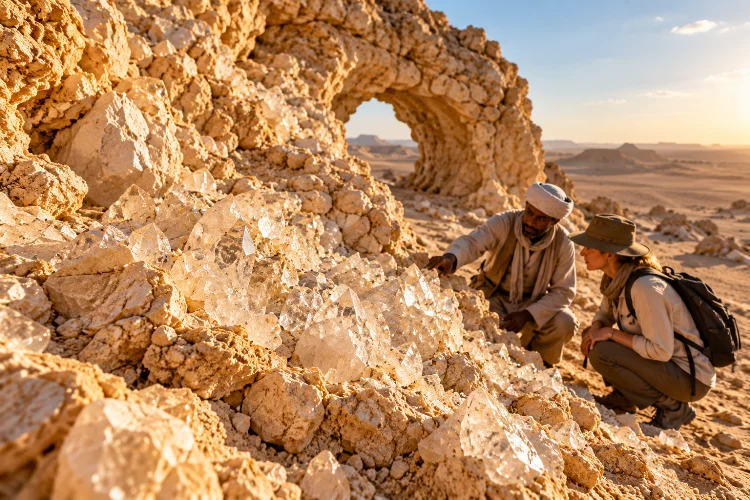
Some places in Egypt’s Western Desert impress you because of their enormous scale. Crystal Mountain does almost the opposite.
It is relatively compact, but once you step closer, the apparently ordinary desert hill begins sparkling with exposed crystals, old cave structures, fractured limestone, and strange openings shaped by a geological history stretching millions of years.
Exploring the Crystal Mountain area on a Western Desert journey is often included between the Black Desert, Agabat Valley, and White Desert.
Many tours stop briefly for photographs, but the site becomes much more interesting when you understand what you are actually seeing. Despite its popular name, Crystal Mountain is not simply a mountain made from quartz.
Geological research describes Gebel Crystal as the exposed remains of a large paleokarst cave system developed mainly in Upper Cretaceous chalky limestone, with abundant calcite crystals occurring through its cave deposits.
Give it more than ten minutes, and a roadside attraction becomes a fascinating open-air geology lesson.
Understand What Crystal Mountain Really Is
The name “Crystal Mountain” creates a slightly misleading first impression.
You might imagine a conventional mountain filled with enormous quartz crystals. Instead, researchers describe the site as an unroofed or exposed ancient cave system within the karst landscape between Bahariya and Farafra.
The principal host rock belongs to the Khoman Formation, a chalky limestone unit dating to the Late Cretaceous.
Over immense periods of time, water entered fractures in the carbonate rocks and gradually dissolved parts of them.
Cavities, channels, sinkholes, and underground spaces developed. Minerals later precipitated from water inside some of these spaces, producing calcite-rich cave deposits.
Eventually, erosion removed much of the original cave roof.
What visitors now walk around is essentially part of a geological structure that once existed underground. Egypt’s official tourism portal similarly describes Crystal Mountain as a former underground cave that was later exposed at the surface.
That makes the site far more unusual than its nickname suggests.
Look Closely at the Calcite Crystals
The sparkling mineral surfaces are obviously the star attraction.
Scientific research on Crystal Mountain describes calcite crystals filling cavities and forming features such as flowstones, dripstones, solution channels, stalagmite-like structures, and other cave deposits.
Some documented crystals reach macrocrystalline sizes of up to around 20 centimetres. Sunlight makes these surfaces especially striking.
Walk around slowly and the appearance changes with your angle. Some crystals look almost transparent, while others appear creamy white, grey, honey-coloured, or slightly translucent.
This is also where casual descriptions can become confusing. Crystal Mountain is sometimes promoted as being covered mainly in quartz, but detailed geological studies identify calcite as a major crystal-forming mineral associated with its karst cave structures.
You don’t need specialist equipment to appreciate the difference.
A guide who understands basic geology can point out the cave deposits, fractured host rock, crystal-filled openings, and weathered surfaces without turning the stop into a university lecture.
Read the Landscape as an Ancient Cave
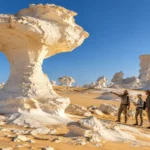
One of the most interesting features is the natural arch often associated with Crystal Mountain.
At first it looks like another unusual desert rock formation. Once you know the site’s history, however, openings like this become clues to the former cave system.
Karst develops when water interacts with soluble rocks such as limestone.
Fractures and joints provide routes for water to penetrate underground. Gradual dissolution enlarges those weak zones into cavities and passages, while mineral-rich water can later deposit calcite inside them.
Research across White Desert National Park documents sinkholes, solution channels, cave remnants, karst windows, flowstones, stalactite- and stalagmite-like structures, and collapsed cave systems. Crystal Mountain is one of the area’s major exposed examples.
So instead of asking only which formation makes the best photograph, try to imagine where the original rock surface once continued overhead.
You are effectively standing inside the remains of an ancient subterranean enviroment.
Crystal Mountain Records a Very Different Climate
Today’s Western Desert is extraordinarily dry, which makes its ancient cave systems even more interesting.
Karst features require water. The existence of extensive old cave deposits therefore helps geologists reconstruct periods when environmental conditions were very different from those seen today.
Research on karst systems in the Bahariya–Farafra region has identified evidence for significantly wetter conditions during parts of the Miocene. Studies of nearby cave deposits have even documented fossils associated with a humid paleoclimate roughly 11-10 million years ago.
This makes Crystal Mountain more than a collection of pretty crystals.
It forms part of a regional archive of changing climate, groundwater movement, erosion, and landscape development.
The White Desert’s wider karst heritage has scientific value precisely because these formations can preserve clues about ancient rainfall, groundwater chemistry, temperature, vegetation, and long-term environmental change.
Standing in today’s dry Sahara while looking at features produced by ancient water systems creates one of the site’s most memorable contrasts.
Fit Crystal Mountain Into a Bahariya–Farafra Route
Crystal Mountain works especially well as part of a longer Western Desert itinerary rather than as an isolated destination.
It lies on the route connecting Bahariya and Farafra, making it a natural stop between the darker landscapes farther north and the spectacular chalk formations of the White Desert.
Bahariya itself lies about 370 kilometres southwest of Cairo and is commonly used as a gateway for Western Desert journeys.
Farafra provides another useful base. Egypt’s official tourism portal identifies Crystal Mountain, the White Desert, Black Desert, Agabat Valley, and Great Sand Sea among the important excursions accessible from the wider Farafra area.
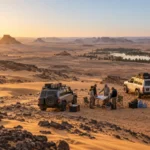
A logical multi-day journey might therefore move through Bahariya, explore the Black Desert, continue toward Crystal Mountain and Agabat, and then spend a night among the White Desert formations.
Seen this way, Crystal Mountain acts almost like a geological bridge between very different landscapes.
Compare It With the White and Black Deserts
One reason Crystal Mountain is so rewarding is its proximity to completely different geological scenery.
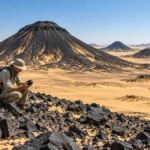
The Black Desert around Bahariya is known for darker hills and black rock fragments associated with volcanic and iron-rich materials. Farther south, the White Desert is dominated by brilliant chalk and limestone formations.
Crystal Mountain introduces yet another process: karst cave development and mineral deposition.
The White Desert Protected Area itself covers approximately 3,133.5 square kilometres and was declared a protected area in 2002. Egypt’s environmental authority describes it as an important landscape for studying karst, fossils, desert ecology, prehistoric remains, and distinctive white chalk formations.
Research likewise describes the national park as an unusually diverse karst landscape containing sinkholes, caves, natural bridges, mushroom formations, towers, domes, and mineral-rich cave deposits.
Travelling through all three landscapes is a useful reminder that the Western Desert is anything but geologically uniform.
Spend Enough Time to Explore on Foot
Crystal Mountain is often treated as a quick roadside stop.
That is convenient but not ideal.
Even 30–45 minutes of slow walking can reveal far more than jumping out of a 4×4, photographing the famous arch, and immediately continuing toward the White Desert.
Walk around authorised areas and change your viewing angle. Look for crystal-filled cavities, weathered chalk, sedimentary layers, openings, fractures, and places where softer material has disappeared.
Morning or later afternoon usually produces better visual contrast than harsh midday light.
The lower sun catches exposed crystal faces, while shadows make cavities and rock textures easier to distinguish. Photographers should consider both close details and wider frames showing the crystal deposits within the barren landscape.
A geological guide becomes particulary useful here because many features are easy to walk past if you do not know what they represent.
Don’t Collect the Crystals
A sparkling piece lying on the ground may seem like the perfect souvenir.
Leave it there.
Crystal Mountain belongs to the protected White Desert landscape, and its geological features have scientific as well as scenic value. Geoheritage research specifically highlights the need for conservation and sustainable tourism across these karst sites.
Removing crystals gradually damages the very reason people travel there.
It also separates geological material from its original context. A crystal still attached to a cave deposit can reveal information about how and where it formed; sitting on a shelf at home, most of that meaning disappears.
Avoid breaking formations, carving names into rock, or climbing fragile crystal-covered surfaces for photographs.
Photographing an interesting specimen usually produces a better souvenir anyway – and you do not have to carry a rock through airport security.
Choose a Guide Who Understands More Than the Photo Stops
Western Desert excursions should be arranged through suitable local operators rather than improvised independently.
Experience Egypt recommends using specialized, licensed operators and checking current permits and regulations before desert excursions. Trips around Farafra can range from short outings to multi-night journeys involving camping, hiking, camel travel, or 4×4 exploration.
If geology interests you, ask a few questions before booking.
Does the guide understand why Crystal Mountain is an exposed paleocave? Can they explain the difference between calcite and quartz? Will you actually have time to walk around the formations?
These questions quickly separate a geology-focused expedition from a tour designed primarily to stop, photograph, and drive.
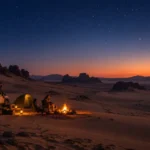
For a longer journey, combine geological interpretation with overnight camping. Sunset and early morning transform the wider Western Desert and give you time to understand how Crystal Mountain fits within the surrounding terrain.
Combine Geology With Farafra’s Oasis Landscape
Not every hour of a Western Desert trip needs to involve rocks.
Farafra offers palm gardens, springs, agriculture, and a small oasis environment that creates a striking contrast with the barren desert outside town. The official tourism portal highlights its gardens of palms, citrus, apricot, carob, and olive trees, as well as hot springs such as Bir Sitta.
Including an oasis stop also makes the journey easier physically.
After dusty 4×4 travel, even a simple shower, hot spring, proper meal, and bed can feel luxurious.
It also adds another historical question: how have people survived and travelled through these desert depressions for centuries?
A balanced itinerary combines geology, landscapes, oasis communities, and camping instead of treating Western Desert travel as a continuous sequence of dramatic viewpoints.
Exploring the Crystal Mountain area on a Western Desert journey becomes far more rewarding once you understand that the site is not simply a sparkling hill.
Geological evidence identifies it as the exposed remains of an ancient karst cave system containing abundant calcite formations within a landscape shaped by water, climate change, erosion, and enormous spans of time.
Give the site enough time to walk, study the natural arch, notice crystal-filled cavities, and imagine the cave before erosion exposed it.
Then place Crystal Mountain within a wider Bahariya–Farafra trip that includes the Black Desert, Agabat Valley, and White Desert.
Book through an experienced authorized operator, confirm current access requirements, and leave every crystal exactly where you find it. The best part of visiting this landscape is learning how to read it – not taking pieces of it home.