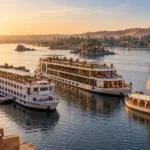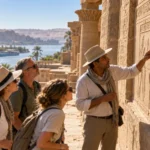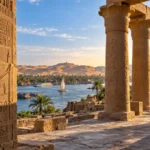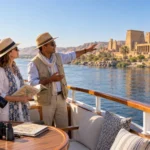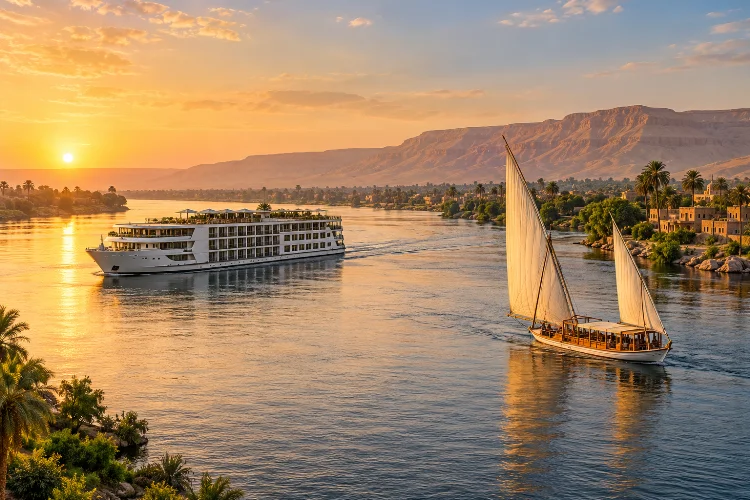
Sailing the Nile sounds romantic no matter which boat you choose. Wake up beside palm-lined riverbanks, spend the morning exploring an ancient temple, return to the water for lunch, and watch villages slide past while the Egyptian sun drops toward the horizon.
The experience, however, can feel completely different depending on your vessel. Comparing luxury Nile cruises and traditional dahabiya journeys is really a choice between two styles of travel.
Large or mid-sized luxury cruisers operate more like floating hotels, offering structured itineraries, extensive facilities, and efficient access to Egypt’s headline archaeological sites.
Dahabiyas are smaller sailing vessels built around a slower rhythm, intimate groups, and the ability to stop in quieter places along the river.
Egypt’s official tourism portal notes that conventional Luxor–Aswan cruises generally take four to five days and combine onboard comfort with daily historical excursions. Dahabiya journeys often take longer because slowing down is part of the point.
Neither option is automatically better. The right one depends on what you expect from the Nile.
Luxury Nile Cruises Feel Like Floating Hotels
A modern luxury Nile cruise is the easier option to understand if you have taken an ocean or river cruise elsewhere.
You have a private cabin, restaurant service, organized excursions, lounges, and usually a large sun deck. Many vessels also offer swimming pools and additional leisure facilities.
Egypt’s tourism authority describes classic cruises as full-board journeys combining comfortable accommodation, food, entertainment, and daily sightseeing.
The biggest advantage is convenience.
Cruise staff manage transportation, meals, schedules, and most of the basic logistics. You can spend the morning walking through Karnak, return to the ship for lunch, then relax while travelling toward the next destination.
The drawback is that schedules tend to be structured. Larger vessels operate around docking arrangements and fixed sailing timetables, so spontaneity is limited.
For travelers who prefer predictability and plenty of onboard comfort, that structure can be a strength rather than a weakness.
A Dahabiya Makes the River the Main Attraction
A traditional dahabiya offers almost the opposite experience.
These relatively small wooden vessels generally use two large sails and carry far fewer passengers than conventional cruise ships.
Modern versions preserve the traditional sailing concept while often providing private bathrooms, air conditioning, comfortable cabins, and well-equipped decks.
Lonely Planet describes dahabiyas as intimate sailing boats, commonly with only a handful of cabins, while National Geographic highlights their ability to bring travelers closer to villages and everyday life along the Nile.
The atmosphere is quieter.
Instead of elevators, large lounges, and entertainment schedules, much of the experience happens on an open deck.
Meals may be shared around one table, passengers get to know one another quickly, and hours can pass simply watching farmers, fishermen, birds, and river islands.
Wind conditions influence sailing. When there is insufficient wind, dahabiyas may rely on assistance from a tug, so the romantic idea of sailing exclusively under canvas is not always realistic.
Still, the slower pace is precisely why many travelers choose them.
Compare the Archaeological Itineraries Carefully
Both options can deliver excellent archaeology, but usually in slightly different ways.
Classic Nile cruises concentrate on the major monuments between Luxor and Aswan. Typical schedules include the Valley of the Kings, Karnak, Luxor Temple, Edfu, Kom Ombo, and Philae.
That makes them highly efficient for first-time visitors.
Luxor alone contains an extraordinary concentration of archaeology.
UNESCO’s Ancient Thebes property encompasses Karnak and Luxor temples on the East Bank and a vast West Bank landscape containing royal tombs, funerary temples, settlements, and thousands of other ancient remains.
A dahabiya can visit many of the same headline sites, but its smaller size may allow additional stops that large ships commonly bypass.
Depending on the itenerary, these can include smaller villages, islands, or lesser-visited archaeological locations such as El Kab. Lonely Planet specifically notes that small dahabiyas can reach stops unavailable to larger vessels.
If seeing the famous monuments efficiently is your priority, the larger cruise works very well. If you want ancient sites mixed with quieter river exploration, the dahabiya has an advantage.
Expect Different Group Dynamics
Passenger numbers dramatically affect the feeling of a Nile journey.
A conventional cruiser may carry dozens of guests. You are not necessarily sightseeing with everyone onboard, but excursions can involve relatively large groups.
That means more people around the buffet, pool, lobby, and docking areas. The upside is greater anonymity – you can socialize when you want and then disappear into your own space.
A dahabiya creates a much more communal environment.
Many boats carry roughly a dozen or so guests, though capacity varies. Lonely Planet notes that small dahabiyas may have only four to ten cabins.
You will likely see the same travelers at breakfast, on archaeological excursions, during afternoon tea, and again at dinner.
For sociable travelers, this can be one of the highlights. For someone who strongly prefers privacy, spending nearly a week with the same small group may feel intense.
Choosing a dahabiya therefore means choosing your social atmoshpere as much as your transportation.
Luxury Means Something Different on Each Boat
Luxury Nile cruisers usually express comfort through facilities.
Think larger cabins or suites, polished dining rooms, broad sun decks, swimming pools, bars, spa-style services on some ships, and a larger staff infrastructure.
The luxury feels familiar and hotel-like.
Dahabiya luxury is often more understated. Instead of numerous facilities, the value comes from space, quiet, personalized service, fewer passengers, slower dining, and uncrowded riverbank moorings.
This distinction matters when comparing prices.
A dahabiya can cost as much as – or sometimes more than – a larger upscale cruise despite having fewer facilities. You are partly paying for low passenger numbers, extended journey time, intimate service, and a more exclusive experience.
Do not compare the two simply by counting amenities.
Ask what kind of luxury actually matters to you. A rooftop pool may be more valuable to one traveler, while another would happily trade it for breakfast beside an empty stretch of river.
Dahabiyas Usually Encourage Slower Travel
Classic cruises between Luxor and Aswan commonly take four or five days, depending on direction and schedule.
That is remarkably efficient considering how much archaeology can be included.
A dahabiya journey often stretches the experience over a longer period. The route may begin around Esna rather than central Luxor, with land transfers connecting the sailing section to major monuments.
That extra time changes your relationship with the Nile.
On a conventional ship, river travel often connects archaeological excursions. On a dahabiya, the act of sailing itself becomes a major part of the trip.
You notice agricultural landscapes more closely. Stops at islands feel meaningful rather than simply filling time. Meals become longer, and there is rarely pressure to find something to do every hour.
Travelers with a limited Egypt itinerary may prefer the efficiency of a classic cruise. Those deliberately planning a slow trip will probably appreciate the dahabiya rhythm more.
Dining and Evenings Feel Very Different
Large luxury vessels generally provide greater food variety.
Buffets or multi-course menus can combine Egyptian and international dishes, and larger ships may offer bars, lounges, entertainment, or evening activities.
Egypt’s official cruise information specifically highlights full-board dining and entertainment as standard features of many journeys.
A dahabiya usually has fewer dining choices but can feel more personal.
Meals are often served communally, sometimes outdoors, with Egyptian cooking playing a larger role. Because there are fewer guests, dining becomes part of the social experience rather than simply another ship facility.
Evenings are quieter too.
Instead of scheduled entertainment, you may find yourself drinking tea on deck and watching the riverbank disappear into darkness.
Some travelers will find that magical. Others may be bored after the second evening.
Be realistic about which category you fall into.
Consider Comfort, Mobility, and Practical Needs
Smaller does not always mean easier.
Large luxury vessels may have more extensive infrastructure, but accessibility varies considerably between individual ships. A dahabiya typically has fewer decks and passengers, yet narrow stairways or compact cabins can present their own challenges.
Never assume either vessel type will meet mobility requirements.
Ask operators directly about stairs, cabin access, boarding arrangements, bathroom design, and distances involved in archaeological excursions.
Internet availability also varies. Even when Wi-Fi is advertised, a moving boat on the Nile is not the ideal place to expect flawless high-speed connections.
If you need reliable connectivity for work, ask recent passengers or the operator about actual performance rather than simply checking whether “Wi-Fi” appears on an amenity list.
Climate control matters too. Most quality modern vessels offer air conditioning, but confirm this particulary when booking a smaller traditional-style boat.
Think About Where You Want to Wake Up
One of the most underrated differences is the view outside your cabin in the morning.
Large cruise ships usually dock at established berths, sometimes beside several other vessels. It is possible to open your curtains and find another cruise ship immediately outside.
The benefit is convenient infrastructure and fast transfers.
Dahabiyas have shallower drafts and greater flexibility about where they stop. Their smaller scale can allow them to moor near islands, villages, or quieter riverbanks inaccessible to large cruisers.
Waking beside agricultural fields or an empty stretch of the Nile can become one of the defining memories of the journey.
For photographers and slow travelers, that alone may influence the choice.
Which Nile Cruise Style Should You Choose?
Choose a luxury Nile cruise if this is your first trip to Egypt, you want to cover major archaeological sites efficiently, prefer a predictable timetable, enjoy resort-style facilities, or only have four or five days available for the river.
Choose a dahabiya if you value small groups, quiet sailing, local landscapes, slower schedules, communal meals, and stops beyond the standard archaeological circuit.
Couples and small groups looking for intimacy often gravitate toward dahabiyas. Families or travelers wanting more facilities may prefer conventional ships, although individual vessels differ considerably.
The smartest approach is to compare specific boats instead of assuming every luxury cruiser or dahabiya offers the same experience.
Read the daily schedule. Check exactly which archaeological excursions are included. Look at cabin dimensions, passenger capacity, meals, guide arrangements, transfers, entrance fees, and optional excursions.
That tells you far more than star ratings.
Comparing luxury Nile cruises and traditional dahabiya journeys ultimately comes down to the kind of Egypt experience you want.
A luxury cruiser makes exploring Luxor, Edfu, Kom Ombo, and Aswan remarkably convenient while providing the facilities of a floating hotel.
A dahabiya trades some of that scale for intimacy. Smaller passenger numbers, slower sailing, flexible riverbank stops, and quieter surroundings make the journey itself just as important as the temples.
Neither is universally superior. Before booking, compare the exact route, group size, sightseeing time, cabin comfort, meals, and included fees rather than choosing based on photos alone.
Decide whether your priority is efficiency or immersion, then pick the boat that matches that travel style. The Nile is extraordinary from either deck – you simply experience it at a different rhythm.