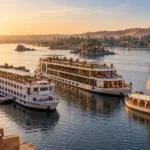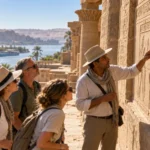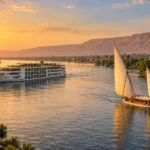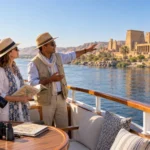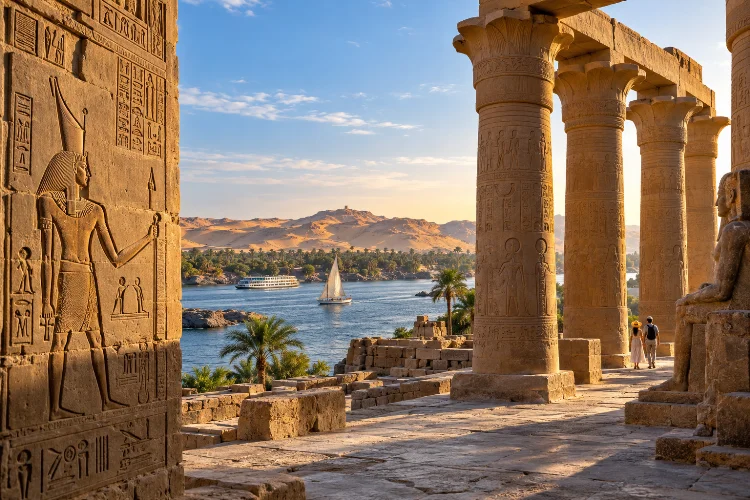
Travelling from Luxor to Aswan is much more than a scenic journey along the Nile.
The route passes through one of the richest concentrations of ancient temples anywhere in Egypt, with monuments representing more than a thousand years of religious, political, and architectural development.
Exploring the historical temples along the Luxor to Aswan route lets you watch Egyptian sacred architecture change almost chronologically.
Around Luxor, enormous New Kingdom complexes such as Karnak reveal the power of pharaohs like Hatshepsut, Seti I, and Ramesses II.
Farther south, temples at Esna, Edfu, and Kom Ombo show how traditional Egyptian religion continued under Ptolemaic and Roman rulers. Finally, Philae near Aswan demonstrates how remarkably long those beliefs survived.
Whether you travel by Nile cruise, dahabiya, road, or a combination of all three, knowing what makes each stop different will prevent the journey from becoming an endless sequence of pylons and columns.
Start With the Monumental Scale of Karnak
Karnak is the best place to begin because almost nothing else along the route prepares you for its size.
Rather than one temple, Karnak is a huge religious complex containing several sacred precincts. The largest was dedicated to Amun, while other areas honored deities including Mut and Montu. Nearly every New Kingdom ruler left some kind of architectural mark here.
The famous Great Hypostyle Hall is the obvious highlight. Its roof was supported by 134 massive columns, with the central columns rising about 21 metres. Much of the hall’s construction and decoration is associated with Seti I and Ramesses II.
But avoid treating the hall as the entire site.
Walk toward Hatshepsut’s surviving obelisk, the sacred lake, smaller chapels, and later additions. Karnak works almost like an architectural archive because successive kings modified earlier spaces rather than starting from scratch.
Give yourself at least two hours if possible. Archaeology enthusiasts could easily spend much longer.
See a More Intimate Side of Thebes at Luxor Temple
Luxor Temple is smaller than Karnak, but its historical layers are easier to read.
Amenhotep III created much of its main New Kingdom core during the 14th century BCE. Ramesses II later added a major courtyard, colossal statues, and the enormous entrance pylon.
Only one of the original pair of approximately 25-metre obelisks remains outside the entrance today; the other has stood in Paris since the 19th century.
The temple was also connected to Karnak by the processional Avenue of Sphinxes. During the ancient Opet Festival, religious processions linked the two complexes.
Later history makes Luxor particularly fascinating.
Romans incorporated parts of the complex into a military fort and transformed one interior space into a Roman sanctuary. This means the temple is not frozen in one pharaonic period – it records changing political and religious uses over centuries.
Visit toward late afternoon if your schedule allows. The changing light makes the columns and stone reliefs especially atmospheric.
Stop at Esna for Color and Ancient Astronomy
Esna often receives less attention than Edfu or Karnak, which makes it one of the more interesting stops for travelers who enjoy details.
The surviving Temple of Khnum lies roughly 45 kilometres south of Luxor. Most of the original Ptolemaic temple has disappeared, leaving its monumental pronaos, or columned vestibule, which was largely decorated during the Roman period.
Its ceiling and columns are particularly important.
Modern conservation has removed centuries of soot and grime, revealing vivid colors, astronomical scenes, inscriptions, constellations, zodiac imagery, and details that researchers could barely see before restoration began.
Recent work has also uncovered previously unknown painted inscriptions. Look upward rather than simply photographing the columns from eye level.
The ceiling transforms the monument from another stone hall into a complex religious representation of the cosmos. For visitors interested in Egyptian astronomy or conservation, Esna can be one of the most unexpected highlights of the entire journey.
Explore One of Egypt’s Best-Preserved Temples at Edfu
Edfu gives you something different again: extraordinary preservation.
Dedicated to Horus, the falcon god, the present temple was begun under Ptolemy III in 237 BCE and completed under Ptolemy XII in 57 BCE. Construction therefore lasted around 180 years.
Its preservation makes the ancient temple layout particularly easy to understand.
You approach enormous pylons decorated with scenes of royal power, then pass into an open courtyard surrounded by columns. Beyond that are hypostyle halls and increasingly restricted interior rooms leading toward the sanctuary.
Two granite falcon statues representing Horus stand near the monumental entrance.
What makes Edfu especially valuable is how clearly it shows the progression from public exterior spaces toward sacred interior zones. Instead of seeing random rooms, you can follow how religious access became increasingly controlled as worshippers moved deeper inside.
Allow time for the wall scenes too. They document ceremonies, sacred processions, and myths connected with Horus rather than serving as simple decoration.
Notice the Double Design of Kom Ombo
Kom Ombo immediately feels unusual because its architecture is effectively duplicated.
The temple was dedicated to two major deities: Sobek, the crocodile god associated with water and fertility, and Harwer, or Horus the Elder. Because of this dual dedication, the temple contains parallel axes leading toward seperate sanctuaries.
The existing structure largely belongs to the Graeco-Roman period, although an earlier New Kingdom temple once occupied the site.
Look for the beautifully varied column capitals as well as inscriptions recording festivals and religious rituals. One famous Roman-period relief is commonly interpreted as showing medical or surgical instruments.
Its riverside setting also makes Kom Ombo especially enjoyable from a Nile vessel.
Unlike some sites that require lengthy transfers from the river, the temple appears dramatically beside the water. Late-afternoon visits can be particulary memorable when the sandstone begins catching warmer light.
Kom Ombo proves that even temples constructed during later Egyptian history could remain strongly connected to ancient religious traditions.
Finish the Route at the Island Temples of Philae
Philae makes an almost perfect ending because both its ancient history and modern conservation story are remarkable.
The sanctuary was primarily dedicated to Isis, with major surviving structures dating to the Ptolemaic period. The temple continued functioning remarkably late, and the site preserves the last known dated hieroglyphic inscription, carved in 394 CE.
Later, portions of the complex were converted for Christian use.
Yet the monuments visitors see today are no longer on their original island.
During the international campaign associated with the construction of the Aswan High Dam, the temples were dismantled and reconstructed on nearby Agilkia Island to protect them from flooding.
UNESCO’s rescue campaign for Nubian monuments ran from 1960 to 1980 and included Philae among its most important projects.
Arriving by boat adds significantly to the experience.
Columns, pylons, and the graceful Kiosk of Trajan gradually appear against the water, making Philae feel more isolated than many other major Egyptian temples.
Pay Attention to How Temple Architecture Changes
Seeing these monuments in geographical order reveals a pattern that is easy to miss when visiting them seperately.
Karnak and Luxor largely reflect the massive royal temple architecture of the New Kingdom. Monumental pylons, colossal statues, obelisks, processional routes, and enormous column halls communicated both religious meaning and state power.
Farther south, Edfu, Kom Ombo, Esna, and Philae preserve later Ptolemaic and Roman traditions.
Their rulers were often Greek or Roman, but the temples deliberately maintained Egyptian architectural forms and religious imagery. Pharaoh-style kings continued appearing before Egyptian gods long after Egypt had entered a very different political world.
That continuity is one of the most interesting themes of the journey.
Instead of ancient Egyptian religion suddenly ending after the age of the pharaohs, the temples demonstrate gradual adaptation extending into the Roman and early Christian periods.
UNESCO describes the Upper Egyptian and Nubian monuments as evidence for precisely this long cultural sequence.
Avoid Temple Fatigue by Slowing the Journey Down
Visiting several monumental temples in a few days can become surprisingly exhausting.
After enough pylons, columns, gods, and hieroglyphs, even extraordinary archaeology may start to blur together.
Rather than trying to photograph every relief, give each temple one or two themes.
At Karnak, focus on royal expansion and monumental scale. At Esna, study color and astronomy. Use Edfu to understand temple layout, Kom Ombo to examine dual religious design, and Philae to explore the survival of Isis worship and modern heritage conservation.
This makes individual sites easier to remember.
A knowledgeable Egyptologist can also make a huge difference. Reliefs that initially look repetitive often contain information about political legitimacy, festivals, mythology, offerings, warfare, and ritual.
Bring water, sun protection, and comfortable shoes as well. Even when transfers are short, the Upper Egyptian enviroment can make several hours of walking much more tiring than expected.
Give Luxor and Aswan Extra Time
A standard river itinerary can show you the major temples, but it rarely exhausts the archaeology available at either end of the route.
UNESCO’s Ancient Thebes property includes not only Karnak and Luxor temples but the enormous Theban necropolis across the Nile, including the Valley of the Kings, Valley of the Queens, funerary temples, settlements, and thousands of archaeological remains.
Aswan deserves similar flexibility.
Philae belongs to the UNESCO-listed Nubian monuments, a wider archaeological landscape that also includes Elephantine, ancient granite quarries, historic tombs, and sites farther south toward Abu Simbel.
Adding a night before and after your river journey can therefore improve the trip significantly.
Instead of squeezing every monument into cruise excursion windows, you can explore the two anchor cities at a more comfortable pace.
Exploring the historical temples along the Luxor to Aswan route is one of the best ways to understand how Egyptian religion and architecture evolved over centuries.
Karnak demonstrates the monumental ambitions of New Kingdom rulers, Luxor preserves layers of royal and Roman history, while Esna reveals extraordinary color and astronomical imagery.
Edfu provides one of Egypt’s clearest surviving temple layouts, Kom Ombo introduces an unusual double sanctuary, and Philae combines the enduring cult of Isis with one of archaeology’s greatest modern rescue projects.
Don’t rush simply to collect temple names. Give each monument enough time to reveal what makes it different.
Whether you travel by cruise ship, dahabiya, or road, approach the route as one connected historical journey and the Nile becomes far more than transportation between ancient ruins.